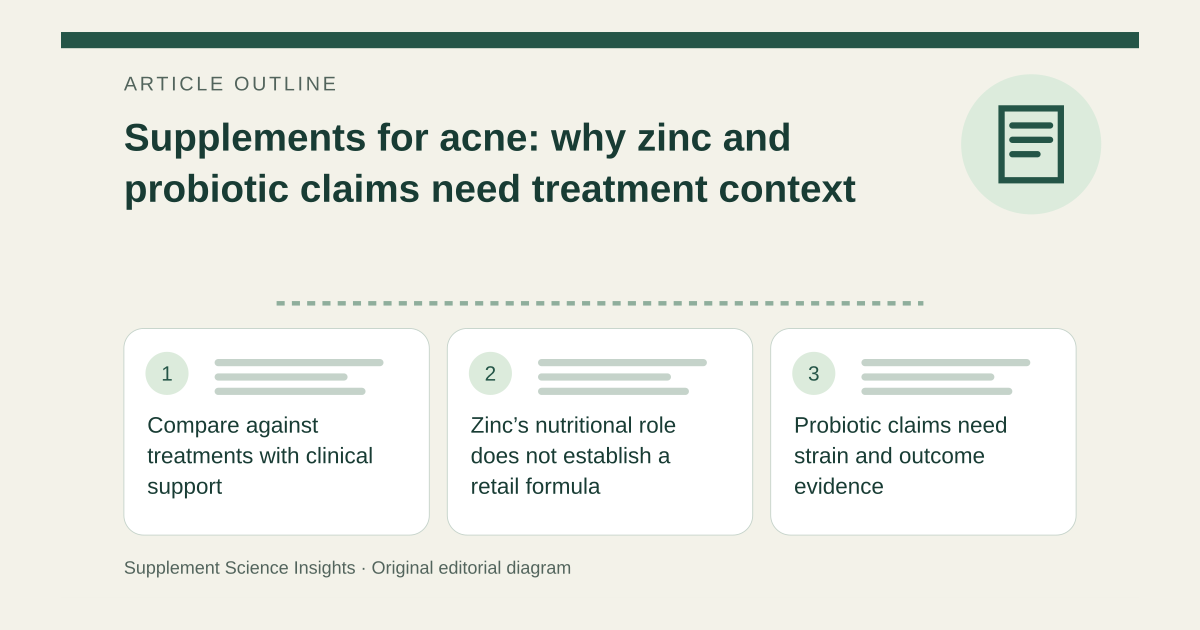
Compare against treatments with clinical support
The AAD guideline supports treatments including benzoyl peroxide and topical retinoids, with prescription options selected according to severity and circumstances. Persistent, scarring or distressing acne warrants clinical care rather than repeated purchases of clear-skin products. [1]
Zinc’s nutritional role does not establish a retail formula
The evidence limitation does not mean every possible zinc preparation has been disproved. It means a universal recommendation cannot be built from a nutrient’s normal function or a product label. Excess zinc can also interfere with copper status, so more is not automatically better. [1][2]
Probiotic claims need strain and outcome evidence
A gut-health claim or a change in bacteria is not the same as a demonstrated reduction in acne lesions with the finished product. Check the exact preparation and outcome rather than treating all probiotics as interchangeable skin treatments. [3]
Review the full formula and other care
Beauty blends may duplicate nutrients already supplied by food or a multivitamin. AAD advises checking whether the ingredients and doses are actually needed and compatible with existing medicines. Pregnancy also changes which acne treatments are appropriate; discuss it before starting treatment. [4][1]
Avoid measuring success only by a marketing promise
Imagine a supplement is described as supporting clear skin but offers no comparable acne outcome evidence. A dermatologist can assess the acne type and build a treatment plan, while a dietary review addresses any separate nutritional gap. [1][3]
| Observation or claim | Useful response |
|---|---|
| Nutrient function | Not proof of acne benefit |
| Probiotic blend | Needs preparation-specific evidence |
| Persistent or scarring acne | Seek a treatment plan |
Sources for this article
- American Academy of Dermatology issues updated guidelines for the management of acne
Source consulted: 2026-09-20. This is a reference resource, not a claim that we conducted the studies or tested a product. - Zinc - Health Professional Fact Sheet
Source consulted: 2026-09-20. This is a reference resource, not a claim that we conducted the studies or tested a product. - Dietary Supplements: What You Need to Know
Source consulted: 2026-09-20. This is a reference resource, not a claim that we conducted the studies or tested a product. - Should I take vitamins or supplements for my skin?
Source consulted: 2026-09-20. This is a reference resource, not a claim that we conducted the studies or tested a product.