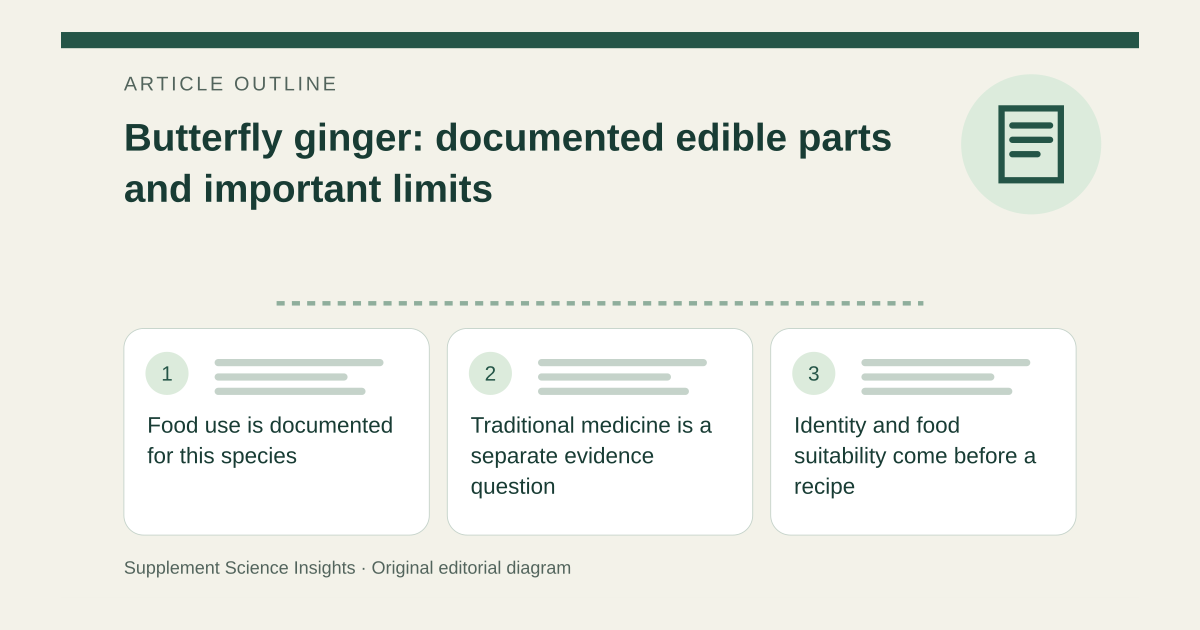
Food use is documented for this species
NParks describes young buds and flowers eaten after light steaming in Thailand, flowers used as vegetables in Hawaii, and edible rhizomes used for starch extraction. These are botanical food-use records. Butterfly ginger is not the same species as standard culinary ginger. [1][2]
Traditional medicine is a separate evidence question
The same profile lists customary medicinal uses and explicitly notes that some therapeutic effects are not scientifically verified. A food-use record does not establish a treatment dose, prove medicinal efficacy or make a concentrated oil suitable to swallow. [1]
Identity and food suitability come before a recipe
Imagine white flowers on a plant labeled ginger suggest a garnish. Do not use appearance or a common name alone: confirm the species, edible part and food-grade growing conditions. The records above describe Hedychium coronarium rather than every ornamental ginger with white flowers. [1][2]
| Item | Interpretation |
|---|---|
| Hedychium coronarium buds/flowers | Documented food uses |
| A traditional remedy | Not automatically clinically validated |
| Unknown ornamental plant | Do not infer food suitability |
Sources for this article
- NParks | Hedychium coronarium
Source consulted: 2026-09-20. This is a reference resource, not a claim that we conducted the studies or tested a product. - Ginger, Zingiber officinale – Wisconsin Horticulture
Source consulted: 2026-09-20. This is a reference resource, not a claim that we conducted the studies or tested a product.