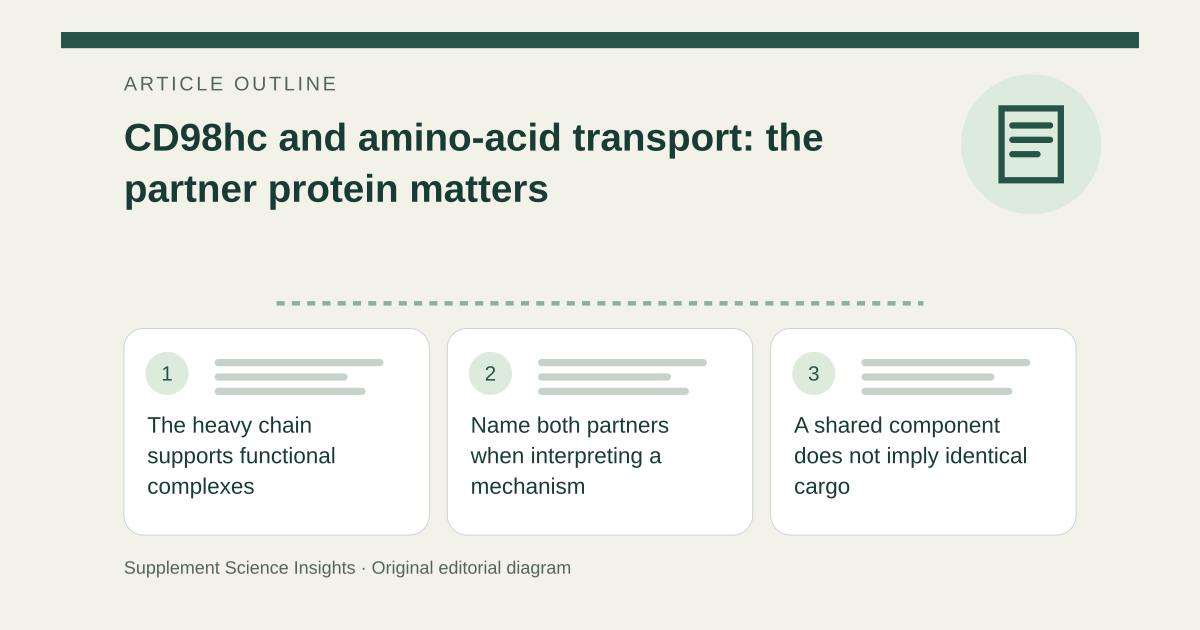
The heavy chain supports functional complexes
The curated UniProt record describes SLC3A2 as helping transporter assembly and trafficking to the cell membrane. It pairs with members of the SLC7 family in disulfide-linked heterodimers. [1]
The light-chain partner helps determine which substrates the complex exchanges. CD98hc is therefore not simply a universal pore that transports all amino acids in the same way. [1]
Name both partners when interpreting a mechanism
For example, the SLC3A2/SLC7A11 complex exchanges extracellular cystine for intracellular glutamate. A different SLC7 partner gives a different transport context. [1]
A laboratory finding about one complex cannot automatically support a claim that a dietary supplement improves amino-acid uptake throughout the body. The relevant transporter, tissue and measured outcome would need to be established. [1]
A shared component does not imply identical cargo
Imagine two studies both mention CD98hc but examine different SLC7 partners. Comparing their results requires identifying those partners; the shared heavy-chain name alone is insufficient to establish that the same exchange process was measured.
| Detail | Interpretation |
|---|---|
| SLC3A2 | Heavy-chain partner |
| SLC7 subunit | Helps determine substrate specificity |
| Transport mechanism | Not a supplement efficacy result |
Sources for this article
- UniProt P08195 — human SLC3A2 amino-acid transporter heavy chain
Source consulted: 2026-09-17. This is a reference resource, not a claim that we conducted the studies or tested a product.