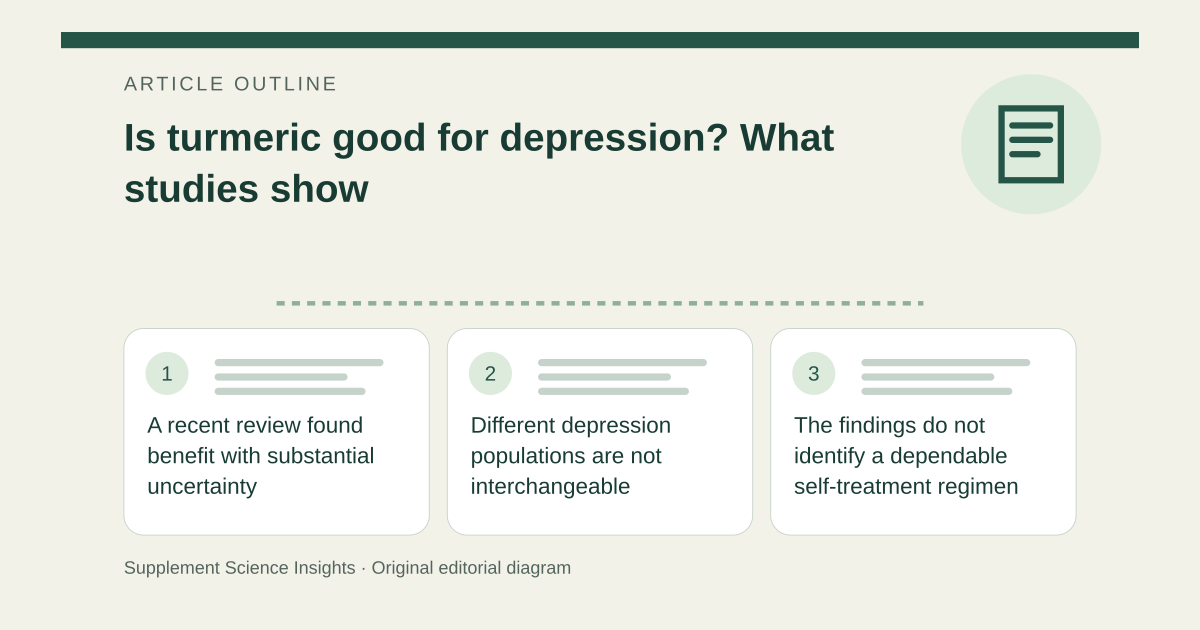
A recent review found benefit with substantial uncertainty
The abstract of a 2026 systematic review reports nineteen randomized trials covering depression or depressive symptoms. Both pooled categories favored curcumin, but between-study heterogeneity was high. The authors specifically described the observed effect as fragile when testing the stability of their analysis. [1]
Different depression populations are not interchangeable
Depressive symptoms in a chronic-disease study do not necessarily represent diagnosed major depression. A separate review of chronic-disease populations noted that depression was not always the primary study focus and that score changes could not reliably be translated into meaningful severity-category improvements. [2]
The findings do not identify a dependable self-treatment regimen
Different preparations and treatment settings cannot be converted into a universal turmeric powder or curcumin dose. The available review-level evidence also does not establish equivalence to an antidepressant or justify stopping one. Enhanced absorption changes exposure and may introduce safety concerns. [1][3][4]
Get help for persistent or severe symptoms
Loss of interest, impaired functioning, sleep changes or other distressing symptoms warrant professional attention. Seek immediate help for thoughts of suicide or an immediate safety concern; in the United States, call or text 988, or use emergency services for an imminent danger. Do not wait for a supplement trial to finish. [5]
Improvement should be assessed in the whole treatment context
Imagine mood improves after starting curcumin while therapy and medication also change. That experience cannot isolate the supplement effect. Review symptoms, functioning and adverse effects with the clinician while keeping prescribed treatment changes supervised. [4][1]
| Finding | Interpretation |
|---|---|
| Pooled improvement | Promising signal |
| High study variability | Less predictable individual result |
| Fragile sensitivity analysis | Confidence remains limited |
| Concurrent treatment changes | Cannot isolate supplement benefit |
Sources for this article
- Efficacy of curcumin in depression: A grade-assessed systematic review and meta-analysis of randomized controlled trials.
Source consulted: 2026-09-21. This is a reference resource, not a claim that we conducted the studies or tested a product. - Frontiers | Potential therapeutic benefits of curcumin in depression or anxiety induced by chronic diseases: a systematic review of mechanistic and clinical evidence
Source consulted: 2026-09-21. This is a reference resource, not a claim that we conducted the studies or tested a product. - Turmeric: Usefulness and Safety | NCCIH
Source consulted: 2026-09-21. This is a reference resource, not a claim that we conducted the studies or tested a product. - Mental Health Medications - National Institute of Mental Health (NIMH)
Source consulted: 2026-09-21. This is a reference resource, not a claim that we conducted the studies or tested a product. - Caring for Your Mental Health - National Institute of Mental Health (NIMH)
Source consulted: 2026-09-21. This is a reference resource, not a claim that we conducted the studies or tested a product.