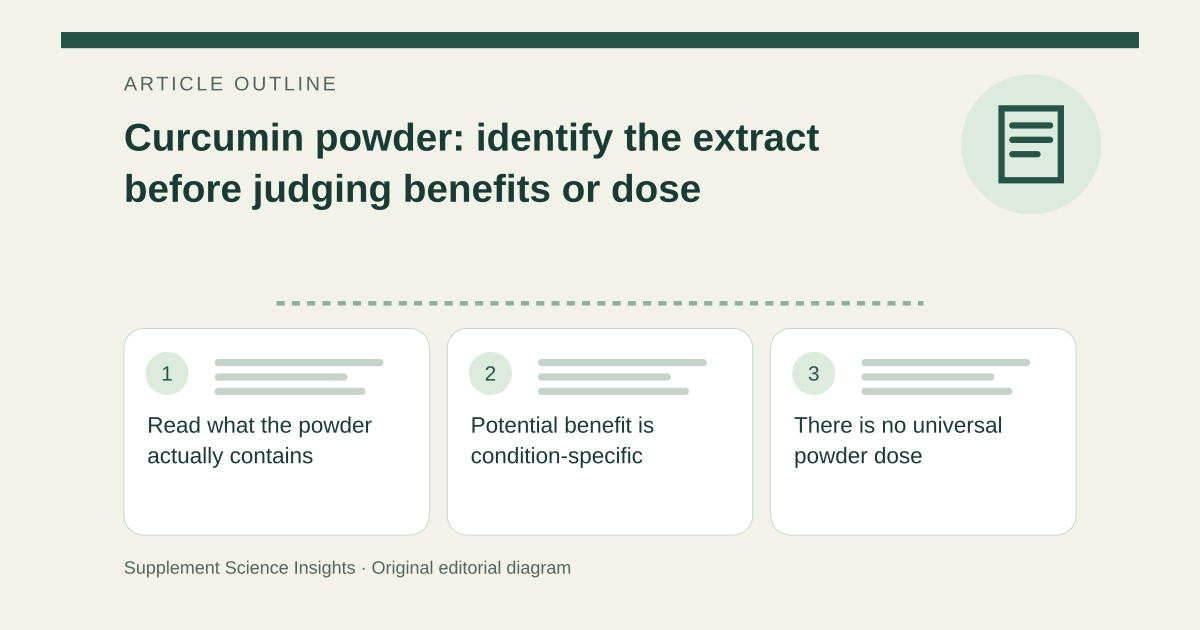
Read what the powder actually contains
Turmeric spice contains several constituents, including curcuminoids. A standardized extract can concentrate those compounds, while another product may add carriers or absorption enhancers. Look for the serving weight, declared curcuminoid content and complete ingredients rather than assuming the entire scoop is pure curcumin. [1][2]
Potential benefit is condition-specific
NCCIH describes preliminary positive findings for some knee osteoarthritis outcomes but says higher-quality evidence is needed. It does not establish definite benefit for every other health condition. A powder format does not make a product equivalent to the preparation used in research. [1]
There is no universal powder dose
A useful dose must retain the formulation, clinical purpose and treatment context. The inspected guidance does not justify one daily spoonful for inflammation, memory and digestive complaints together. A volume scoop without an ingredient concentration cannot be converted into a reliable curcumin amount. [1][2]
Absorption enhancement does not guarantee safety
Piperine can increase curcumin bioavailability. NCCIH also reports liver injury with some enhanced-absorption preparations and gastrointestinal side effects with oral turmeric. Stop the product and seek advice for dark urine, jaundice, poor appetite or unexplained fatigue. Review medicinal use during pregnancy, breastfeeding or prescription treatment. [1]
Keep the arithmetic separate from the health claim
Imagine a 500 mg extract states 95% total curcuminoids. Multiplication gives 475 mg total curcuminoids, not necessarily 475 mg pure curcumin. The calculation clarifies composition; it does not establish that the serving treats a particular condition. [2][1]
| Label item | Interpretation |
|---|---|
| 500 mg extract at 95% | 475 mg total curcuminoids |
| Unspecified spice powder | Cannot assign that same concentration |
| Higher absorption claim | Needs separate benefit and safety evidence |
Sources for this article
- Turmeric: Usefulness and Safety | NCCIH
Source consulted: 2026-09-21. This is a reference resource, not a claim that we conducted the studies or tested a product. - Botanical Dietary Supplements Background Information - Consumer
Source consulted: 2026-09-21. This is a reference resource, not a claim that we conducted the studies or tested a product.