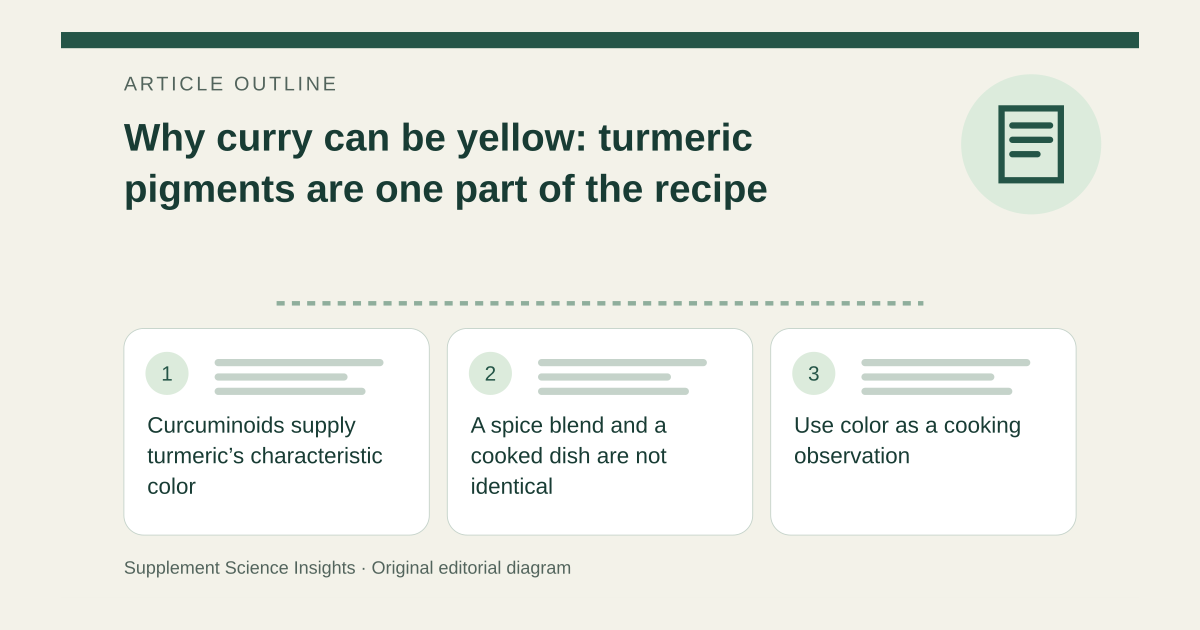
Curcuminoids supply turmeric’s characteristic color
Oregon State’s Linus Pauling Institute identifies curcuminoids as the principal yellow-orange pigments in turmeric. Curcumin is one member of that group. A small amount can visibly affect a dish, but the color does not measure a clinical dose or establish an anti-inflammatory effect from that meal. [1]
A spice blend and a cooked dish are not identical
Curry powder is a mixture and its turmeric and curcumin content vary. A cooked dish adds further ingredients and water or fat, changing what is seen. Comparing two yellow dishes therefore does not establish that they contain equal turmeric amounts, and a less-yellow dish need not be missing an essential ingredient. [1]
Use color as a cooking observation
Imagine the same spice blend is added to a pale sauce and a darker tomato-rich base. Their finished appearance can differ even with the same spoonful of spice. Adjust flavor according to the recipe; do not keep adding turmeric solely to imitate a photograph or assume the brightest sample is the most beneficial. [1]
| Choice | Practical interpretation |
|---|---|
| Turmeric | Contributes yellow-orange pigments |
| Curry powder | Variable mixture of spices |
| Finished color | Not a curcumin assay |
Sources for this article
- Curcumin | Linus Pauling Institute | Oregon State University
Source consulted: 2026-09-20. This is a reference resource, not a claim that we conducted the studies or tested a product.