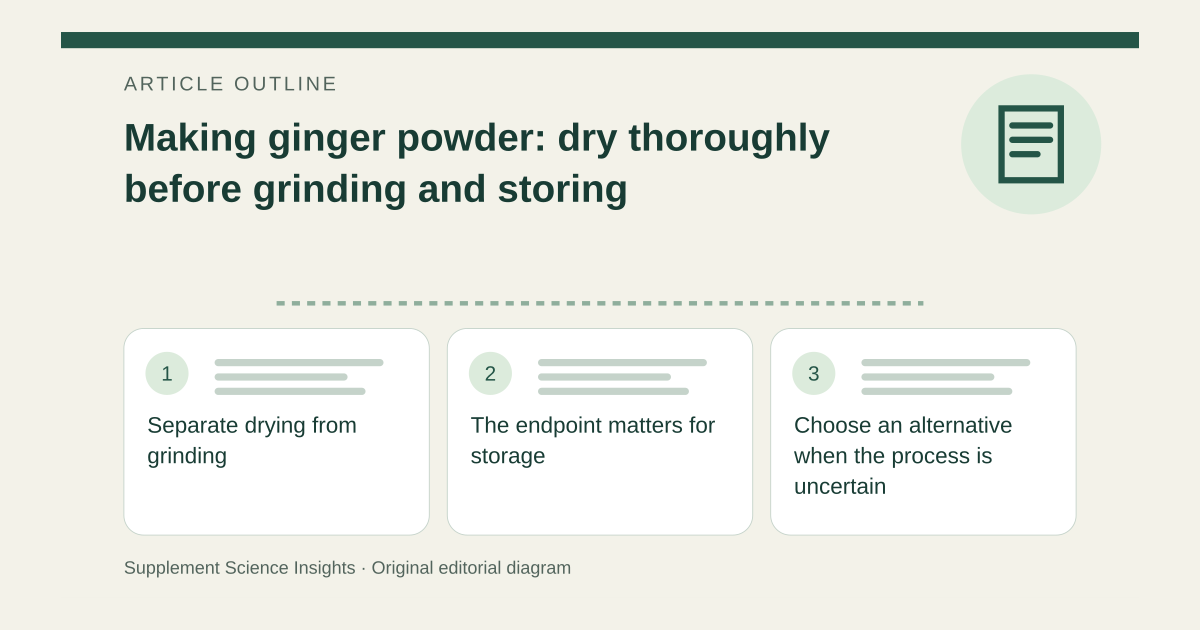
Separate drying from grinding
Clean the ginger, prepare reasonably even pieces and dry them before grinding. NC Cooperative Extension describes using a dehydrator until the material is very dry, or an oven at 200°F, about 93°C. It does not give a universal number of hours. Follow the equipment’s food-drying instructions and check progress rather than treating a timer alone as proof of dryness. [1]
The endpoint matters for storage
Wet centers in thick pieces are a different problem from an apparently dry surface. Grind only adequately dried material, allow it to cool as appropriate and keep the resulting powder protected from moisture. A fine texture does not prove low enough moisture for dependable storage, and adding fresh material back to the jar changes the conditions. [1][2]
Choose an alternative when the process is uncertain
Imagine a batch remains bendable or damp inside after the expected time. Do not seal it as finished powder merely because the outside looks dry. Continue an appropriate controlled drying process or choose freezing for fresh ginger instead. Ordinary air drying in a humid kitchen is not interchangeable with validated equipment instructions. [1][3]
| Choice | Practical interpretation |
|---|---|
| Dry before grinding | Grinding is not preservation |
| 200°F oven method | Approximately 93°C; not a universal duration |
| Damp material | Not ready for dry storage |
Sources for this article
- Ginger and Turmeric: Tropical Superfoods for the Garden - Caldwell County Center | N.C. Cooperative Extension
Source consulted: 2026-09-20. This is a reference resource, not a claim that we conducted the studies or tested a product. - Food Storage Conditions — Utah State University Extension
Source consulted: 2026-09-20. This is a reference resource, not a claim that we conducted the studies or tested a product. - Storing Fresh Ginger • AnswerLine • Iowa State University Extension and Outreach
Source consulted: 2026-09-20. This is a reference resource, not a claim that we conducted the studies or tested a product.