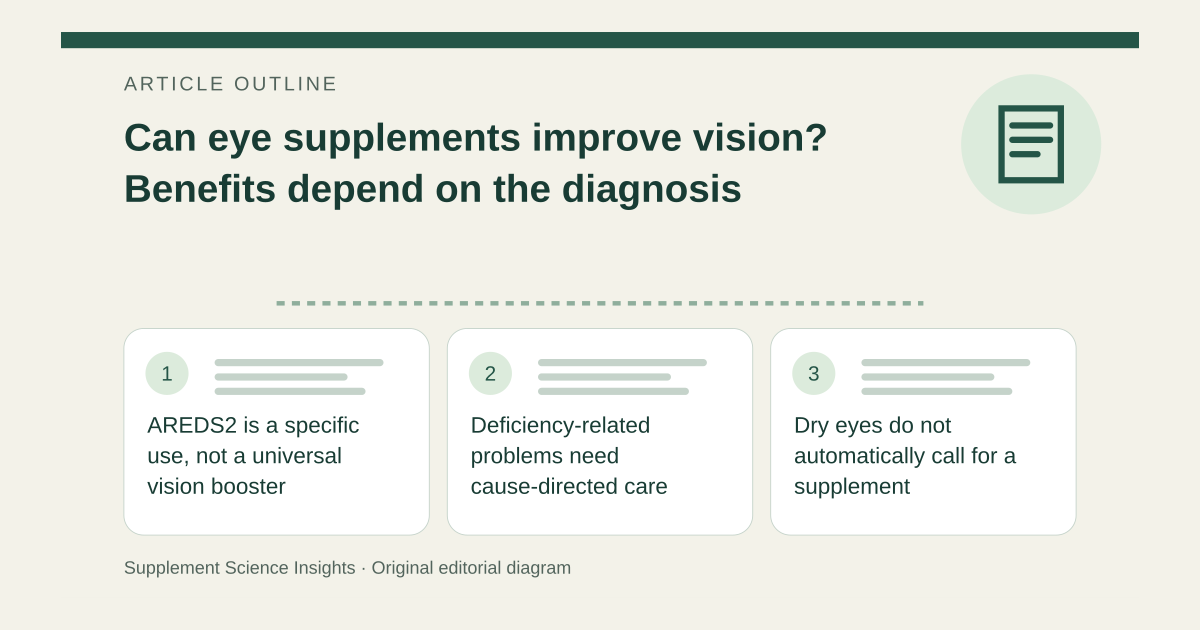
AREDS2 is a specific use, not a universal vision booster
NEI describes a benefit in slowing AMD progression for selected disease stages, including intermediate AMD. The formula does not prevent early AMD from progressing to intermediate AMD and is not equivalent to an ordinary multivitamin. Slowing future loss is different from promising restoration of all vision already lost. [1]
Deficiency-related problems need cause-directed care
Vitamin A deficiency can affect night vision and the eye surface; NICE also lists visual problems among possible B12 deficiency findings. If a deficiency is present, treatment should address its cause and clinical context. These facts do not establish that extra nutrients improve every case of blurry vision. [2][3]
Dry eyes do not automatically call for a supplement
NEI describes artificial tears and other cause-specific approaches to dry eye. An oral capsule does not establish whether the problem is tear production, evaporation, eyelids or another condition. Persistent symptoms need assessment and a treatment matched to the cause. [4]
More vitamins can introduce risk
Excess preformed vitamin A can itself be harmful, and high-dose eye formulas can duplicate other supplements. Smoking history matters when a product contains beta-carotene. Review the actual formula and medicine list rather than assuming an eye-health label guarantees suitability. [2][1][5]
Match the purchase to the examination
Imagine one person has intermediate AMD and another has unexplained recent blurring. The same eye-supplement advertisement does not establish the same treatment for both. New or urgent symptoms require eye care rather than waiting to see whether a bottle works. [1][6]
| Situation | Relevant decision |
|---|---|
| Selected AMD stage | Consider the specific formula with the clinician |
| Suspected deficiency | Assess and treat the cause |
| Unexplained vision change | Eye evaluation before supplement selection |
Sources for this article
- AREDS 2 Supplements for Age-Related Macular Degeneration (AMD) | National Eye Institute
Source consulted: 2026-09-21. This is a reference resource, not a claim that we conducted the studies or tested a product. - Vitamin A and Carotenoids - Health Professional Fact Sheet
Source consulted: 2026-09-21. This is a reference resource, not a claim that we conducted the studies or tested a product. - Recommendations | Vitamin B12 deficiency in over 16s: diagnosis and management | Guidance | NICE
Source consulted: 2026-09-21. This is a reference resource, not a claim that we conducted the studies or tested a product. - Dry Eye | National Eye Institute
Source consulted: 2026-09-21. This is a reference resource, not a claim that we conducted the studies or tested a product. - Dietary Supplements: What You Need to Know
Source consulted: 2026-09-21. This is a reference resource, not a claim that we conducted the studies or tested a product. - NHS: Dry eyes
Source consulted: 2026-09-21. This is a reference resource, not a claim that we conducted the studies or tested a product.