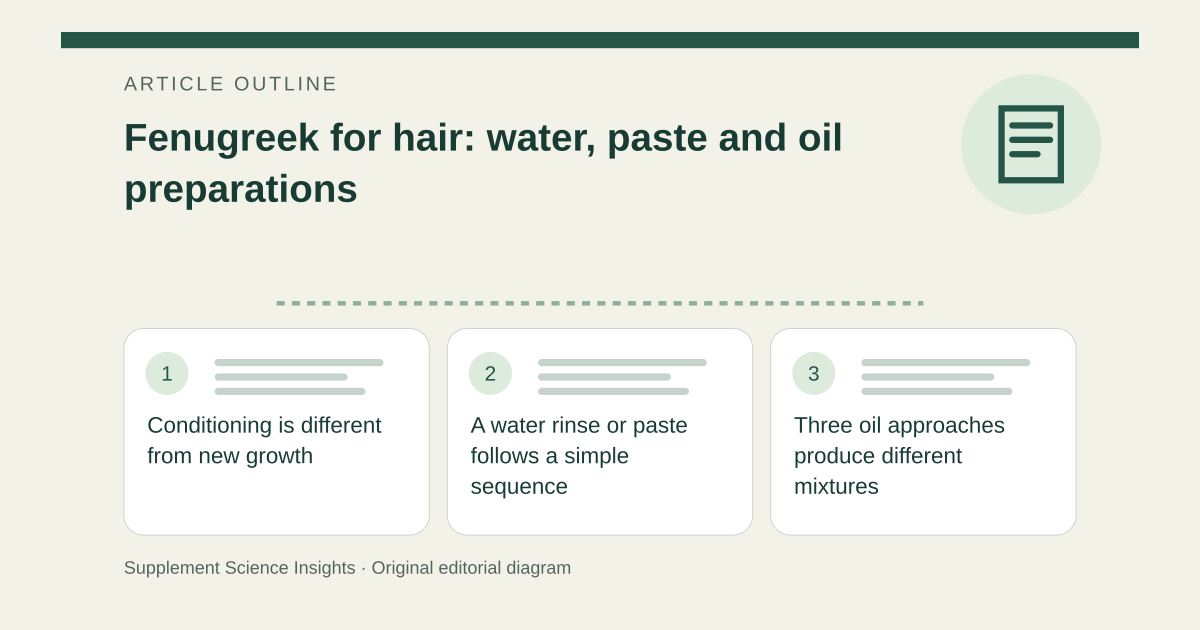
Conditioning is different from new growth
Fenugreek mucilage can bind water and form films, which helps explain cosmetic interest in texture and conditioning. A recent review describes preliminary topical research, including a formulated gel, but does not establish that kitchen seed mixtures reverse every cause of thinning. [1]
A water rinse or paste follows a simple sequence
Traditional use includes soaking seeds and making a paste. For a rinse, the conceptual sequence is clean seeds and equipment, water contact, then straining; for a paste, the softened material is ground instead. These steps describe preparation, not a validated therapeutic recipe. The reviewed evidence does not establish an effective seed-to-water ratio, soaking time, application frequency or leave-on duration. [2][1]
Three oil approaches produce different mixtures
Cold infusion places dry seed material in a carrier oil before straining. Warm infusion adds controlled heat during that contact. Mixing ground seed directly into oil leaves a suspension rather than a filtered extract. These are practical distinctions between preparation methods, not three proven hair-growth treatments. Solvent and processing conditions change what is extracted, and none establishes equivalence to a studied gel. [3][1]
Preservation and allergy matter
Water, raw materials, inadequate preservation and handling can contaminate cosmetics. Do not assume a homemade water rinse or seed-containing oil is shelf-stable, or add water to a finished cosmetic. Fenugreek can also cause allergic skin reactions; avoid it with known relevant allergy and stop if irritation develops. [4][5]
Choose the goal before experimenting
Imagine hair feels smoother after a rinse but thinning continues. Improved texture does not demonstrate follicle regrowth. Seek assessment of persistent or patchy loss rather than intensifying an unvalidated recipe, and do not treat an oral extract dose as a scalp dose. [1]
| Method | What it produces |
|---|---|
| Soak and strain | Variable aqueous rinse |
| Grind softened seeds | Paste containing solids |
| Cold or warm oil infusion | Oil-soluble extraction, not whole-seed equivalence |
| Powder mixed into oil | Suspension, not validated extract |
Sources for this article
- Fenugreek as a Versatile Cosmetic Ingredient: Phytochemical Profile, Skin-Hair Benefits and Formulation Opportunities
Source consulted: 2026-09-21. This is a reference resource, not a claim that we conducted the studies or tested a product. - Pathophysiology, conventional treatments, and evidence-based herbal remedies of hair loss with a systematic review of controlled clinical trials - PMC
Source consulted: 2026-09-21. This is a reference resource, not a claim that we conducted the studies or tested a product. - Understanding plant to extract ratios in botanical extracts - PMC
Source consulted: 2026-09-21. This is a reference resource, not a claim that we conducted the studies or tested a product. - Microbiological Safety and Cosmetics | FDA
Source consulted: 2026-09-21. This is a reference resource, not a claim that we conducted the studies or tested a product. - Trigonellae foenugraeci semen - herbal medicinal product | European Medicines Agency (EMA)
Source consulted: 2026-09-21. This is a reference resource, not a claim that we conducted the studies or tested a product.