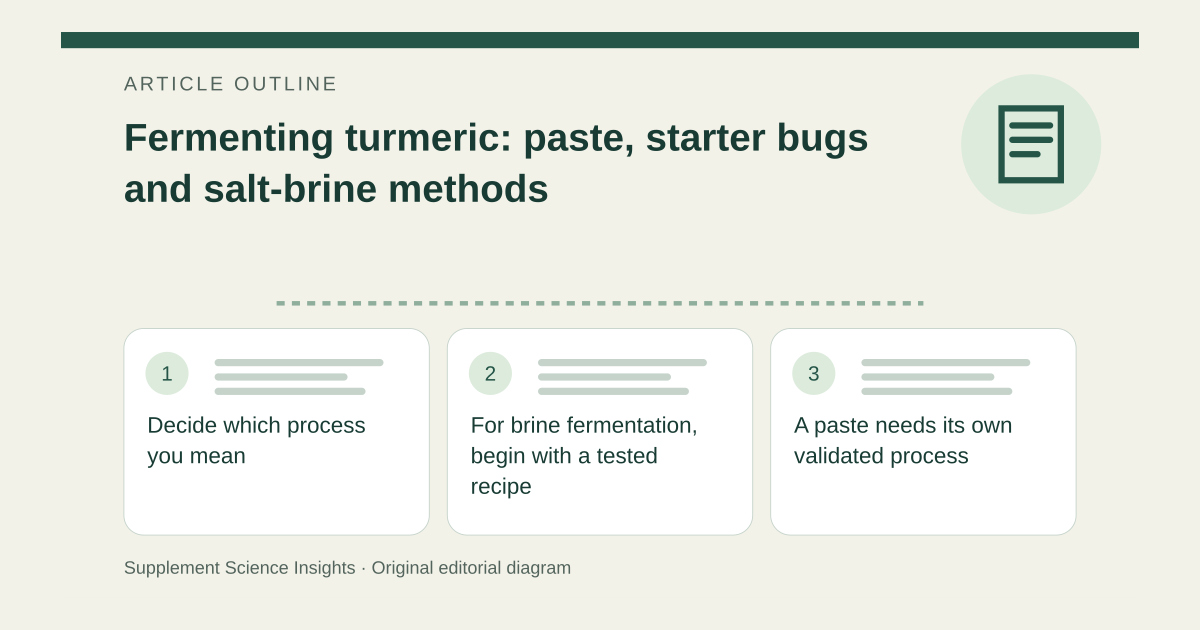
Decide which process you mean
A salt-brined vegetable ferment relies on bacteria producing acid under controlled conditions. A sweet starter culture and a dense paste differ in ingredients, oxygen exposure and handling, so instructions should not be transferred between them. UMN Extension distinguishes lactic-acid, alcohol and other fermentation processes. [1]
For brine fermentation, begin with a tested recipe
Use fresh produce, clean equipment and a food-safe container. Follow the recipe’s specified salt, water, produce preparation, temperature and time; keep produce submerged as directed and use suitable gas-release equipment. OSU warns against altering salt proportions in fermented foods. These principles do not supply a tested formula for fermenting whole turmeric roots. [1][2]
A paste needs its own validated process
Grinding changes the physical mixture and how evenly it can be salted and acidified. Do not assume that a brine recipe or a spoonful of another ferment validates a dense turmeric paste. If a reliable recipe is unavailable, make a small fresh culinary preparation or freeze turmeric for later cooking instead of keeping an improvised paste at room temperature. [1][3]
A turmeric bug is not automatically a safe starter
Bubbling indicates gas production but does not establish the identity of the organisms, adequate acidity or a proven probiotic benefit. Follow a reliable process for the intended beverage, including its handling and storage controls. The sources here do not validate an improvised sugar-and-turmeric starter or provide a safe universal feeding schedule. [1][4]
Verify acidity and storage, not just smell
UMN guidance calls for acidity monitoring during produce fermentation and a final pH of 4.60 or lower with the appropriate completed process. A single reading does not replace the tested recipe or prove every part of a dense mixture is adequately acidified. Follow the specified refrigerated, frozen or validated canning storage method; do not assume a sour jar is shelf-stable. [1][2]
Keep the uncertainty visible
Imagine a turmeric paste bubbles after two days but its recipe gives no acidity target or storage instructions. That is missing process information, not proof that it is ready. Use a tested recipe or ask an Extension food-preservation service to assess the method before making a batch intended for storage. [1][2]
| Project | Needed before proceeding |
|---|---|
| Turmeric in salt brine | Tested produce recipe and exact controls |
| Dense turmeric paste | Process validated for that mixture |
| Sweet starter bug | Reliable beverage-starter instructions |
| Long-term storage | Specified refrigeration, freezing or validated canning |
Sources for this article
- Preserving food at home: Fermentation | UMN Extension
Source consulted: 2026-09-21. This is a reference resource, not a claim that we conducted the studies or tested a product. - Pickle Fact Sheet (SP 50-466) | OSU Extension Service
Source consulted: 2026-09-21. This is a reference resource, not a claim that we conducted the studies or tested a product. - Turmeric – Gardening Solutions
Source consulted: 2026-09-21. This is a reference resource, not a claim that we conducted the studies or tested a product. - Creating a scientific definition of 'fermented foods' - International Scientific Association for Probiotics and Prebiotics (ISAPP)
Source consulted: 2026-09-21. This is a reference resource, not a claim that we conducted the studies or tested a product.