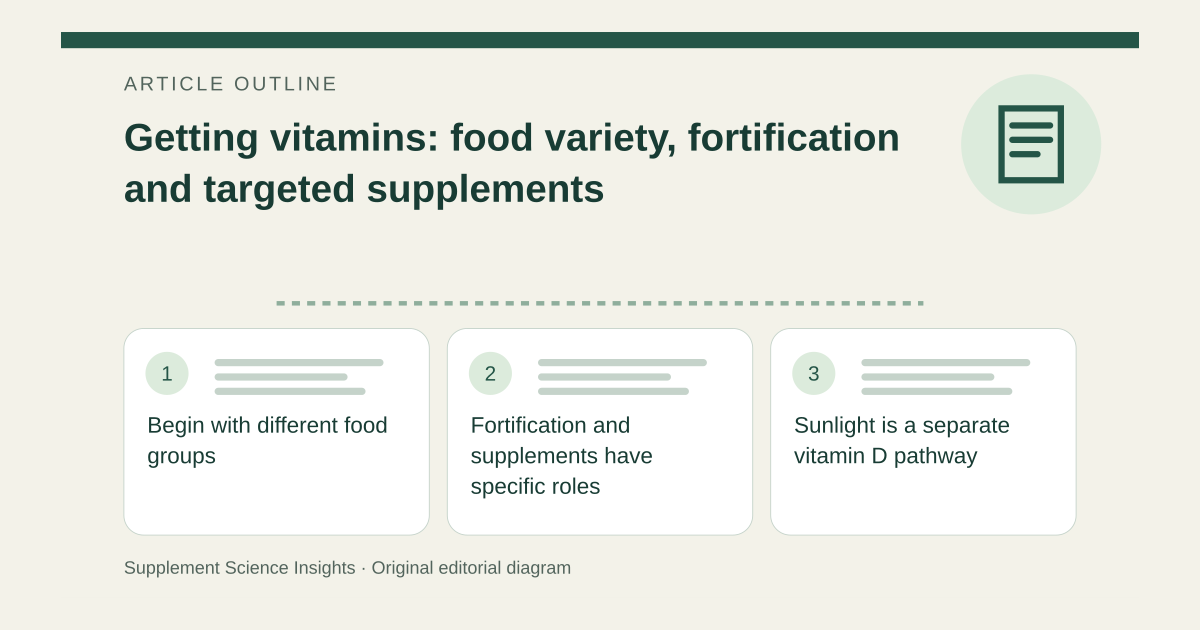
Begin with different food groups
MedlinePlus recommends a varied diet including fruits, vegetables, legumes, whole grains and suitable fortified foods to help meet vitamin needs. Different foods contribute different vitamins. A claim that one food is a complete source of everything should be checked against actual quantities and the rest of the diet. [1]
Fortification and supplements have specific roles
Added vitamins can help fill a particular gap, but the actual product and amount matter. Someone avoiding animal foods, for example, needs a reliable B 12 source rather than assuming every plant food provides it. Supplements can be useful when intake is inadequate or for specific life-stage or medical needs; more of every vitamin is not automatically better. [1]
Sunlight is a separate vitamin D pathway
Skin can synthesize vitamin D following UV exposure, but production varies. NIH ODS advises limiting UV exposure because of skin-cancer risk; a universal number of sun minutes cannot guarantee adequacy. In a hypothetical dietary review, record food and fortified-product contributions, identify specific gaps and assess vitamin D separately rather than treating sunshine as a multivitamin. [2]
| Hypothetical intake review | Useful next question |
|---|---|
| Food variety limited | Which specific vitamins may be low? |
| Fortified drink used | What does its actual panel supply? |
| Time spent outdoors | Does not quantify vitamin D production or supply other vitamins |
Sources for this article
- Vitamins: MedlinePlus Medical Encyclopedia
Source consulted: 2026-09-20. This is a reference resource, not a claim that we conducted the studies or tested a product. - Vitamin D - Health Professional Fact Sheet
Source consulted: 2026-09-20. This is a reference resource, not a claim that we conducted the studies or tested a product.