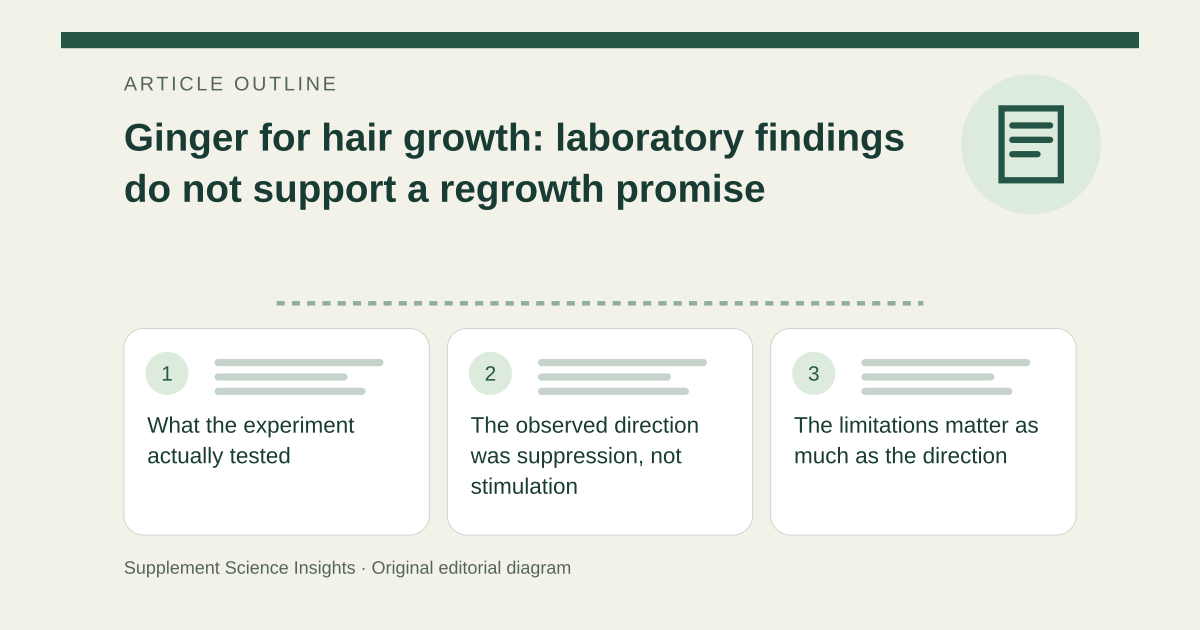
What the experiment actually tested
The 2013 study cultured hair follicles from three male donors for seven days, comparing isolated 6-gingerol with a vehicle control. A separate experiment randomized 36 female mice among three groups, applied two 6-gingerol concentrations or vehicle for ten days and followed the experiment for twenty days. These were laboratory and animal models, not a clinical shampoo trial. [1]
The observed direction was suppression, not stimulation
Researchers reported suppressed follicle growth under the tested conditions and altered hair-cycle behavior in mice. That finding contradicts using this particular experiment as proof of growth promotion. It does not establish that ordinary ginger food intake causes baldness or that a commercial ginger shampoo reproduces the experimental exposure. [1]
The limitations matter as much as the direction
Human tissue came from only three donors; cultured follicles do not represent independent treated patients. The mouse protocol used isolated compound and controlled application rather than a kitchen recipe. Funding came from the Natural Science Foundation of China; authors declared no competing interests. Human effectiveness and tolerable treatment conditions remain unanswered by this experiment. [1]
Choose a plan based on the cause of hair loss
AAD emphasizes diagnosis because different types of hair loss need different approaches and not every treatment works for everyone. Do not delay assessment of ongoing loss while applying stronger ginger mixtures. A scalp reaction to any cosmetic is a reason to stop the product and seek advice when needed. [2][3]
Do not reverse an experiment into a product endorsement
Imagine a shampoo advert cites a ginger laboratory study without explaining its model or result. Check whether it tested people using that shampoo and whether it actually found regrowth. In this case, neither description matches the experiment. [1]
| Evidence | Limit |
|---|---|
| Cultured follicles | Not a patient treatment trial |
| Mouse hair cycle | Not a proven human outcome |
| Isolated 6-gingerol | Not every ginger preparation |
Sources for this article
- 6-Gingerol Inhibits Hair Shaft Growth in Cultured Human Hair Follicles and Modulates Hair Growth in Mice - PMC
Source consulted: 2026-09-21. This is a reference resource, not a claim that we conducted the studies or tested a product. - Hair loss: Diagnosis and treatment
Source consulted: 2026-09-21. This is a reference resource, not a claim that we conducted the studies or tested a product. - How to test skin care products
Source consulted: 2026-09-21. This is a reference resource, not a claim that we conducted the studies or tested a product.