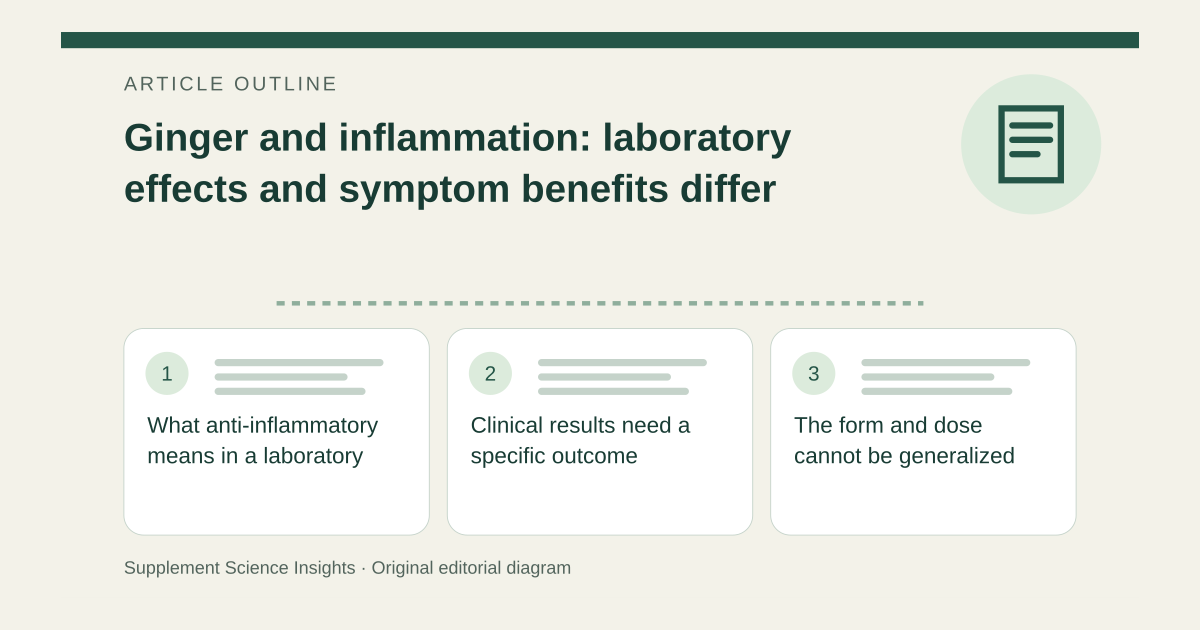
What anti-inflammatory means in a laboratory
The MSK synthesis describes effects of ginger constituents on inflammatory signals in cell and animal work. Such experiments help explain hypotheses. They do not establish that a culinary portion reaches the same exposure or that it improves a patient’s disease. [1]
Clinical results need a specific outcome
NCCIH says supplements might help knee osteoarthritis symptoms, but much of the research is poor quality. It also identifies a possible benefit for menstrual-cramp severity. Neither finding proves a general reduction in all inflammation, and a symptom score is different from structural healing. [2]
The form and dose cannot be generalized
Fresh root, dried powder, tea and concentrated extracts differ. Most clinical research summarized by NCCIH used supplements rather than foods. The inspected guidance does not provide a universal inflammation dose or show that stronger tea is more effective. A studied product would need to match the intended condition and outcome. [2][3]
More is not automatically better
Oral ginger can cause heartburn, diarrhea, abdominal discomfort and mouth or throat irritation. Review medicinal use alongside medicines. A new or worsening painful condition needs its cause evaluated rather than being labeled inflammation and treated indefinitely with ginger. [2]
Match the claim to the level of evidence
Imagine a laboratory experiment changes an inflammatory signal while an advertisement promises arthritis repair. The second claim requires clinical evidence for repair; the laboratory result alone cannot supply it. Keep preparation, outcome and evidence level together. [1][2]
| Evidence | What it can support |
|---|---|
| Cell signaling change | A biological hypothesis |
| Pain-score improvement | A symptom finding in that setting |
| Claim of tissue repair | Needs direct clinical evidence |
Sources for this article
- Ginger | Memorial Sloan Kettering Cancer Center
Source consulted: 2026-09-21. This is a reference resource, not a claim that we conducted the studies or tested a product. - Ginger: Usefulness and Safety | NCCIH
Source consulted: 2026-09-21. This is a reference resource, not a claim that we conducted the studies or tested a product. - Botanical Dietary Supplements Background Information - Consumer
Source consulted: 2026-09-21. This is a reference resource, not a claim that we conducted the studies or tested a product.