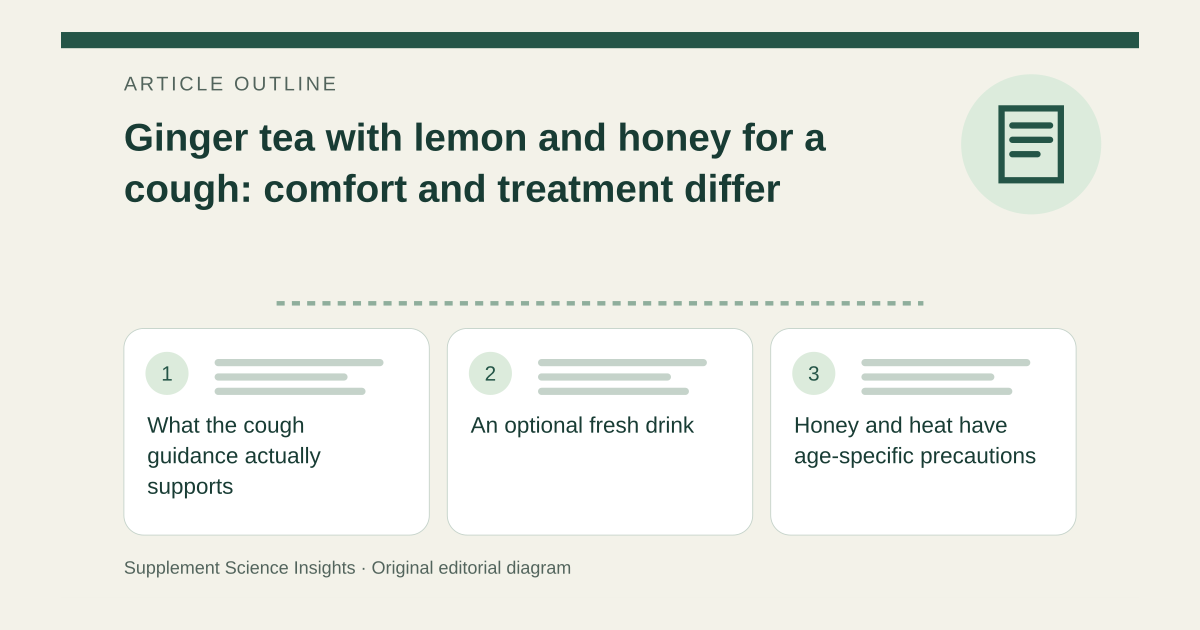
What the cough guidance actually supports
NHS includes warm lemon and honey among self-care options while noting limited evidence. That is not evidence that ginger cures a respiratory infection or that a stronger ginger concentration works better. NCCIH ginger findings mainly concern other outcomes and often use supplements rather than tea. [1][2]
An optional fresh drink
For a culinary example, wash fresh culinary ginger, slice a little into a cup and steep in hot water to taste, then strain. Lemon and a small amount of honey can be added for flavor. Let the drink cool to a comfortable temperature. This is a kitchen suggestion, not a tested cough-treatment formula or dose. [3][4][1]
Honey and heat have age-specific precautions
Do not give honey to a child younger than one year, and do not give hot drinks to small children. A homemade preparation does not automatically make a remedy appropriate for an infant. Ask a pharmacist or clinician about age-appropriate care rather than scaling an adult recipe down. [1]
Know when tea is no longer the relevant next step
Seek prompt assessment for breathing difficulty, chest pain, coughing blood or a rapidly worsening cough. A cough lasting more than three weeks also warrants review. Possible causes include infection, reflux or allergy, which need different approaches. [1]
Judge comfort separately from recovery
Imagine the throat feels temporarily better after a warm drink but the cough worsens later. The initial comfort does not establish that the underlying problem is resolving. Ginger can itself irritate the mouth or throat or cause heartburn, so stop a preparation that aggravates symptoms. [2][1]
| Observation | Interpretation |
|---|---|
| Temporary soothing | Comfort, not proof of infection treatment |
| Honey for an infant | Avoid under one year |
| Worsening or concerning cough | Seek assessment rather than a stronger brew |
Sources for this article
- Cough - NHS
Source consulted: 2026-09-21. This is a reference resource, not a claim that we conducted the studies or tested a product. - Ginger: Usefulness and Safety | NCCIH
Source consulted: 2026-09-21. This is a reference resource, not a claim that we conducted the studies or tested a product. - Ginger - Vegetable Resources Vegetable Resources
Source consulted: 2026-09-21. This is a reference resource, not a claim that we conducted the studies or tested a product. - Storing Food for Safety and Quality — Pacific Northwest Extension PNW612
Source consulted: 2026-09-21. This is a reference resource, not a claim that we conducted the studies or tested a product.