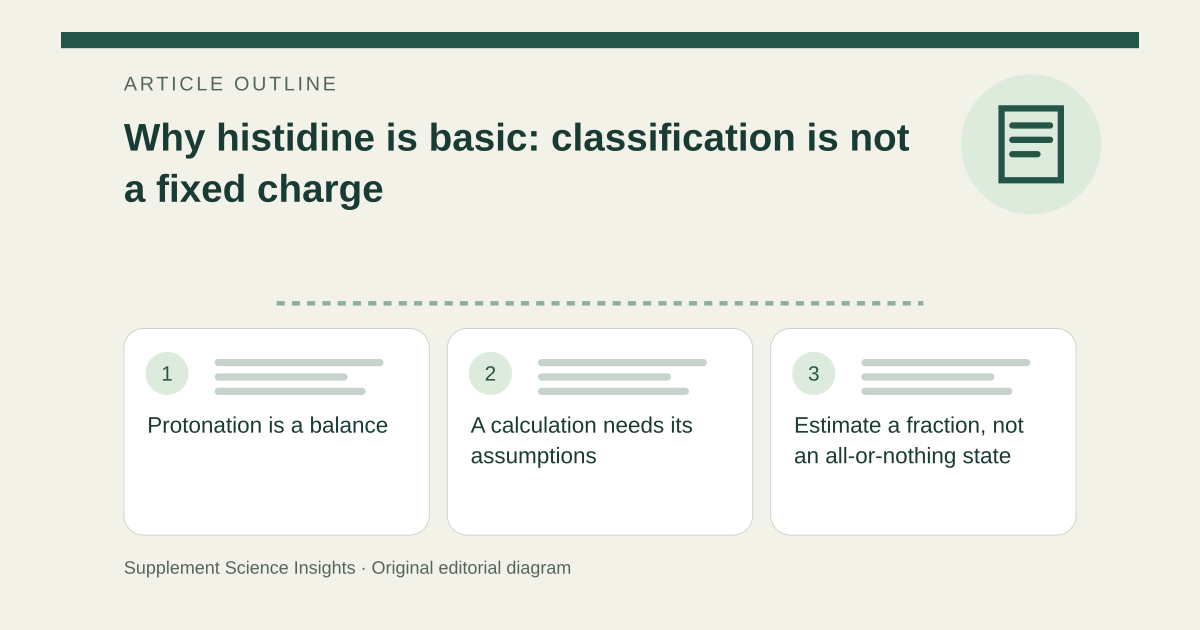
Protonation is a balance
Histidine is classified as basic because its imidazole side chain can accept a proton on a ring nitrogen. Proton acceptance produces a positively charged side chain. Whether most side chains actually carry that charge depends on pH relative to the side-chain pKa. [1][2]
The textbook gives free histidine’s side-chain pKa as approximately 6.0. Near that value, protonated and unprotonated side chains are present in comparable amounts. At a higher pH, the unprotonated form becomes more abundant. [1][2]
This distinguishes histidine from a cartoon that assigns every basic residue a permanent positive charge. Classification and the actual distribution of charge answer different questions. [1][2]
A calculation needs its assumptions
The Henderson–Hasselbalch relationship links the ratio of forms to pH minus pKa. A quoted free-amino-acid value is the assumption for that calculation; it should not be treated as a measurement of a particular site inside a folded protein. [1][2]
Nor does basic in this biochemical sense mean that eating histidine will alkalinize the body or provide a demonstrated health benefit. [1][2]
Estimate a fraction, not an all-or-nothing state
Assume a side-chain pKa of 6.0 and a solution pH of 7.0. The unprotonated-to-protonated ratio is 10 to 1, so approximately 1/11, or 9%, is protonated. This is an illustrative equilibrium calculation.
| Detail | Interpretation |
|---|---|
| pH equals pKa | Approximately equal forms |
| pH one unit higher | 10:1 unprotonated to protonated |
| Basic classification | Not a permanent charge |
Sources for this article
- 26.1 Structures of Amino Acids - Organic Chemistry | OpenStax
Source consulted: 2026-09-17. This is a reference resource, not a claim that we conducted the studies or tested a product. - 26.2 Amino Acids and the Henderson–Hasselbalch Equation: Isoelectric Points - Organic Chemistry | OpenStax
Source consulted: 2026-09-17. This is a reference resource, not a claim that we conducted the studies or tested a product.