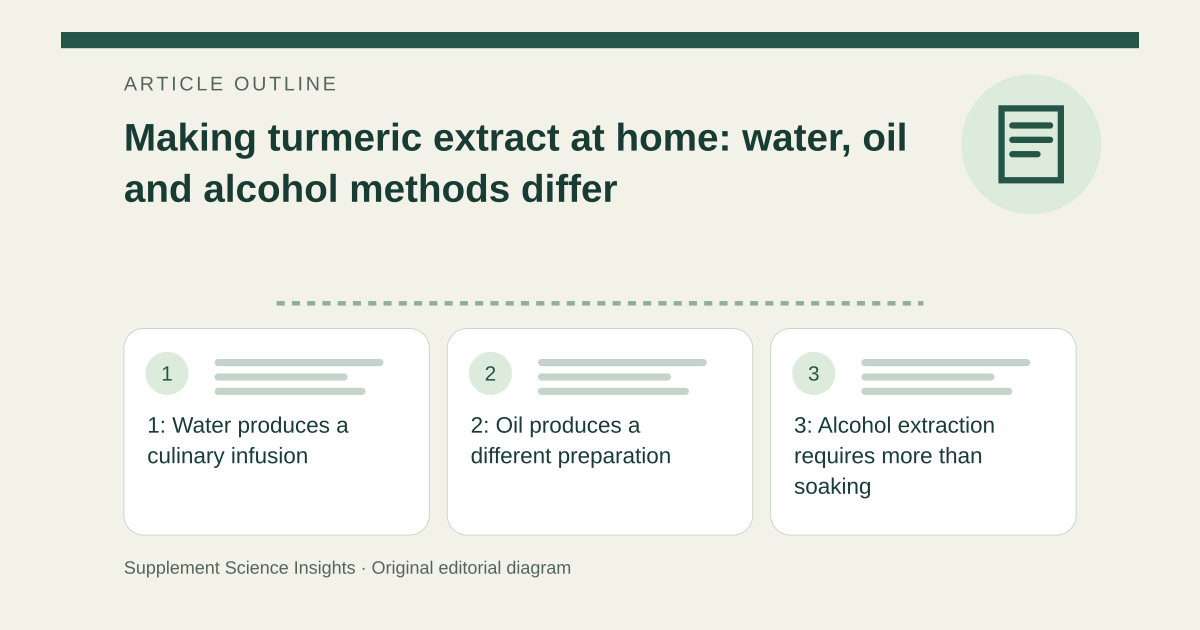
1: Water produces a culinary infusion
For a fresh drink, wash a small piece of culinary turmeric, slice it, steep it in hot water and strain when the flavor suits you. This is an original food example, not a treatment recipe. Curcumin has low water solubility, so a colored infusion does not tell you how much curcumin has dissolved; suspended particles are not the same as a measured solution. [1][2]
2: Oil produces a different preparation
A small amount of grated culinary turmeric can be mixed with edible oil for seasoning. Follow safe infused-oil storage: refrigerate immediately for no more than four days or freeze. Do not infer that oil, turmeric or added lemon makes an improvised jar safe at room temperature. [3][1]
3: Alcohol extraction requires more than soaking
The extraction literature and EMA describe ethanol-derived preparations. Solvent strength, plant-to-solvent ratio, time, filtration and quality testing affect the result. This establishes the method’s existence, not a validated home dose or shelf life. Do not substitute rubbing alcohol, denatured alcohol or industrial solvents for a food preparation, or heat flammable alcohol to concentrate it. [4][5]
Extraction is not purification or standardization
Laboratory extraction may be followed by analytical testing and purification. A homemade colored liquid does not demonstrate curcumin purity, contaminant control or equivalence to a studied supplement. A commercial dropper also does not turn a variable home extract into a known milligram dose. [4]
Choose the result you actually need
Imagine the goal is to flavor a soup. A freshly prepared seasoning is sufficient; a stronger tincture introduces unanswered concentration and storage questions. If the goal is treating symptoms, a home extraction recipe cannot supply the missing clinical evidence. [1][6]
| Approach | Main limitation |
|---|---|
| Water infusion | Low curcumin solubility; not a standardized dose |
| Edible-oil infusion | Cold storage or freezing required |
| Alcohol extraction | Solvent, concentration and quality controls matter |
| Any homemade extract | Not automatically equivalent to a clinical product |
Sources for this article
- Turmeric – Gardening Solutions
Source consulted: 2026-09-21. This is a reference resource, not a claim that we conducted the studies or tested a product. - Properties, Extraction Methods, and Delivery Systems for Curcumin as a Natural Source of Beneficial Health Effects - PMC
Source consulted: 2026-09-21. This is a reference resource, not a claim that we conducted the studies or tested a product. - Herbs and vegetables in oil | OSU Extension Service
Source consulted: 2026-09-21. This is a reference resource, not a claim that we conducted the studies or tested a product. - Various Extraction Techniques of Curcumin—A Comprehensive Review - PMC
Source consulted: 2026-09-21. This is a reference resource, not a claim that we conducted the studies or tested a product. - Curcumae longae rhizoma - herbal medicinal product | European Medicines Agency (EMA)
Source consulted: 2026-09-21. This is a reference resource, not a claim that we conducted the studies or tested a product. - Turmeric: Usefulness and Safety | NCCIH
Source consulted: 2026-09-21. This is a reference resource, not a claim that we conducted the studies or tested a product.