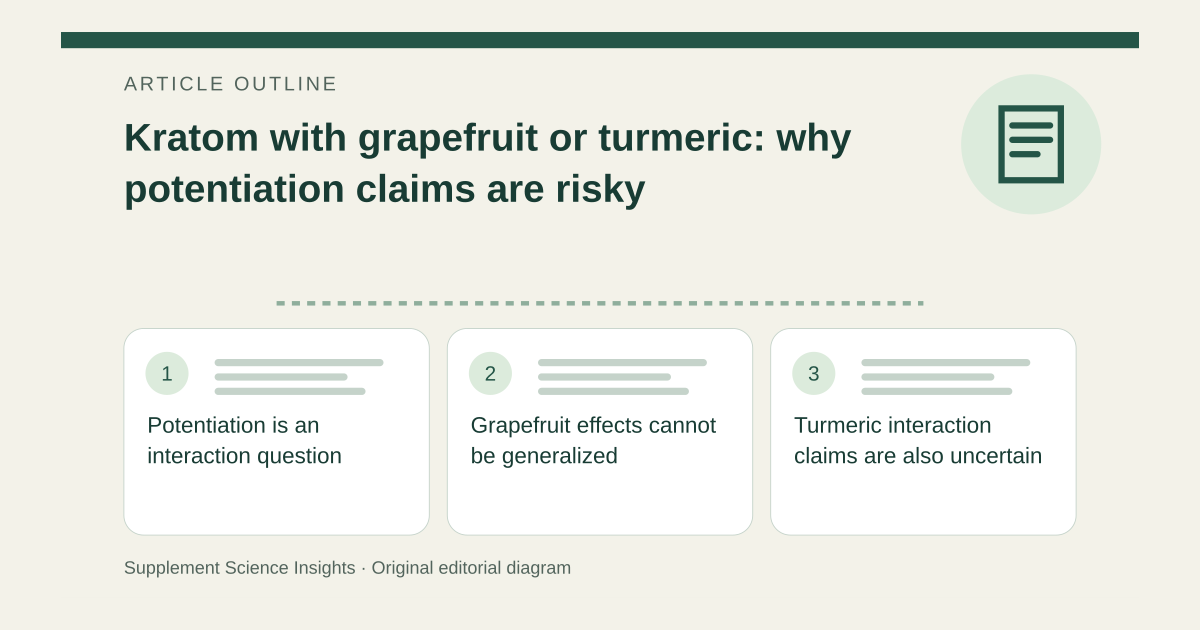
Potentiation is an interaction question
Kratom compounds interact with opioid receptors and can produce stimulant-like as well as sedating effects. NCCIH reports limited human research, dependence potential and serious adverse effects in some cases. Making an effect stronger is not the same as improving a demonstrated medical benefit. [1]
Grapefruit effects cannot be generalized
FDA explains that grapefruit can inhibit intestinal enzymes or affect transporters, changing exposure to some medicines. The direction and size depend on the substance and person. That mechanism does not provide a reliable kratom recipe, safe interval or predictable multiplier. [2][1]
Turmeric interaction claims are also uncertain
Laboratory findings about curcumin and drug-metabolizing enzymes do not consistently predict effects in humans. Products may also include other ingredients that change absorption. These uncertainties are reasons to avoid a potentiation experiment, not grounds for calculating a stronger kratom regimen. [3][1]
Combining substances can increase harm
NCCIH links kratom used with other drugs to severe adverse effects and deaths, while noting that more interaction research is needed. Avoid adding alcohol, sedating substances or other products to amplify effects. If severe drowsiness, breathing difficulty, seizures or collapse occurs, contact emergency services. [1]
Address tolerance, pain or withdrawal directly
Imagine someone seeks a booster because the usual effect has diminished. Regular use can lead to dependence and withdrawal, so escalating combinations may compound the problem. A clinician can help assess pain, withdrawal or other symptoms and discuss treatment rather than relying on an untested interaction. [1]
| Claim | Problem |
|---|---|
| Enzyme inhibition | Not a predictable safe effect |
| Natural booster | Can still interact |
| Stronger sedation | May signal increased harm |
| Less effect over time | Review dependence and the treatment goal |
Sources for this article
- Kratom | NCCIH
Source consulted: 2026-09-21. This is a reference resource, not a claim that we conducted the studies or tested a product. - Grapefruit Juice and Some Drugs Don't Mix | FDA
Source consulted: 2026-09-21. This is a reference resource, not a claim that we conducted the studies or tested a product. - Turmeric | Memorial Sloan Kettering Cancer Center
Source consulted: 2026-09-21. This is a reference resource, not a claim that we conducted the studies or tested a product.