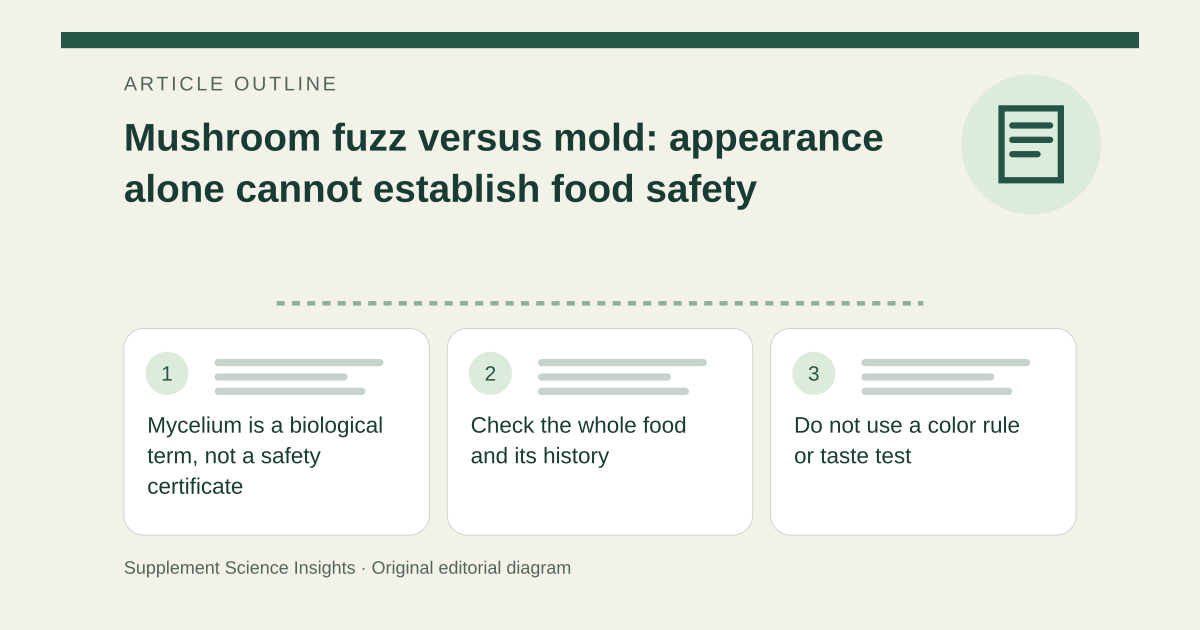
Mycelium is a biological term, not a safety certificate
Fungal hyphae are threadlike structures that form a mycelial network. The presence of fungal threads therefore does not by itself identify the organism or tell you whether a food is safe. Mold and mycelium should not be treated as simple opposite labels for dangerous versus harmless growth. [1]
Check the whole food and its history
Purdue advises avoiding wet or moldy mushrooms. Government fresh-mushroom guidance also identifies slime, abnormal odor and suspicious discoloration as reasons for concern. Those observations matter alongside storage history; a white fuzzy patch does not cancel other signs of deterioration. [2][3]
Do not use a color rule or taste test
Neither white growth nor a normal-looking cap verifies identity or contamination status. Do not taste questionable material to decide whether it is safe. When growth is unfamiliar or the mushrooms are deteriorating, discard the suspect food rather than relying on a photograph to authenticate it. [3][2]
Storage helps prevent deterioration but cannot reverse it
Refrigerate fresh mushrooms promptly and follow appropriate handling directions. Dry products need protection from moisture. Washing, drying or cooking is not evidence that an already suspect product has been restored to its original condition. [3][4]
Separate an observation from the conclusion
Imagine two packages both show pale surface fuzz, but one also has slime and an abnormal smell. Calling both mycelium from their color would discard relevant evidence. The useful conclusion for uncertain food is to avoid eating it, not to invent an identity. [3][1]
| Observation | What it cannot prove |
|---|---|
| White fuzz | A harmless organism |
| Normal-looking cap | Absence of contamination |
| Refrigerated since purchase | That pre-existing spoilage was reversed |
Sources for this article
- 24.1 Characteristics of Fungi - Biology 2e | OpenStax
Source consulted: 2026-09-21. This is a reference resource, not a claim that we conducted the studies or tested a product. - mushroom - FoodLink - Purdue Extension
Source consulted: 2026-09-21. This is a reference resource, not a claim that we conducted the studies or tested a product. - Proper Handling of Fresh Mushrooms
Source consulted: 2026-09-21. This is a reference resource, not a claim that we conducted the studies or tested a product. - Food Storage Conditions — Utah State University Extension
Source consulted: 2026-09-21. This is a reference resource, not a claim that we conducted the studies or tested a product.