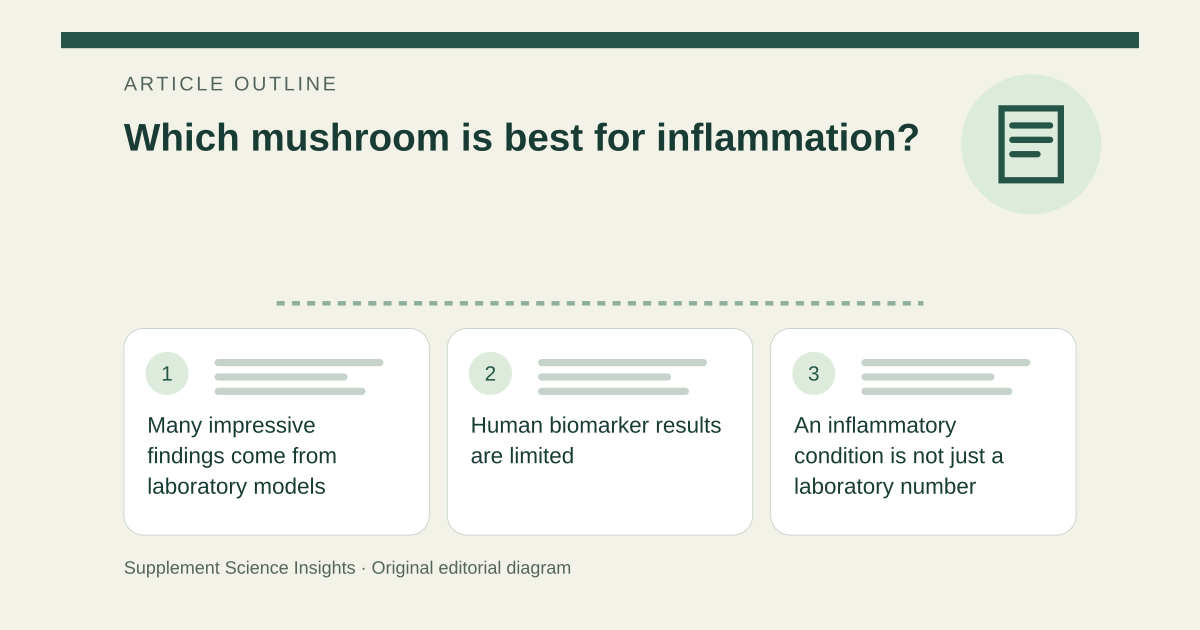
Many impressive findings come from laboratory models
Reishi and chaga have shown effects on inflammatory pathways in preclinical studies. Those experiments do not establish a useful dose, long-term safety or benefit for arthritis, bowel disease or another diagnosis. [1][2]
Human biomarker results are limited
A review of edible mushrooms found limited evidence involving an inflammatory marker, with many poor-quality studies and Mushroom Council funding. A reishi meta-analysis also rated its evidence very low certainty. Neither creates a reliable best-species ranking. [3][4]
An inflammatory condition is not just a laboratory number
A useful treatment should improve the relevant symptoms, function or disease course with acceptable harms. Supplement side effects and interactions remain possible even when a product is marketed as anti-inflammatory. [5][6]
Keep the actual outcome in focus
Imagine a blend advertises reduced cytokines in cells. Someone with inflammatory arthritis should ask whether the same product improved clinical disease in people, not simply whether a pathway changed. Do not replace prescribed treatment on that basis. [5]
| Finding | Missing clinical question |
|---|---|
| Cell pathway changes | Does the person improve? |
| Lower biomarker | Does disease control improve? |
| One preparation studied | Does this blend match? |
| Natural anti-inflammatory | What are the harms? |
Sources for this article
- Reishi Mushroom | Memorial Sloan Kettering Cancer Center
Source consulted: 2026-09-21. This is a reference resource, not a claim that we conducted the studies or tested a product. - Chaga Mushroom | Memorial Sloan Kettering Cancer Center
Source consulted: 2026-09-21. This is a reference resource, not a claim that we conducted the studies or tested a product. - An Assessment of Mushroom Consumption on Cardiometabolic Disease Risk Factors and Morbidities in Humans: A Systematic Review - PMC
Source consulted: 2026-09-21. This is a reference resource, not a claim that we conducted the studies or tested a product. - The Nutritional Significance of Ganoderma lucidum on Human Health: A GRADE‐Assessed Systematic Review and Meta‐Analysis of Clinical Trials - PMC
Source consulted: 2026-09-21. This is a reference resource, not a claim that we conducted the studies or tested a product. - Dietary Supplements: What You Need to Know
Source consulted: 2026-09-21. This is a reference resource, not a claim that we conducted the studies or tested a product. - Mushroom Dietary Supplements
Source consulted: 2026-09-21. This is a reference resource, not a claim that we conducted the studies or tested a product.