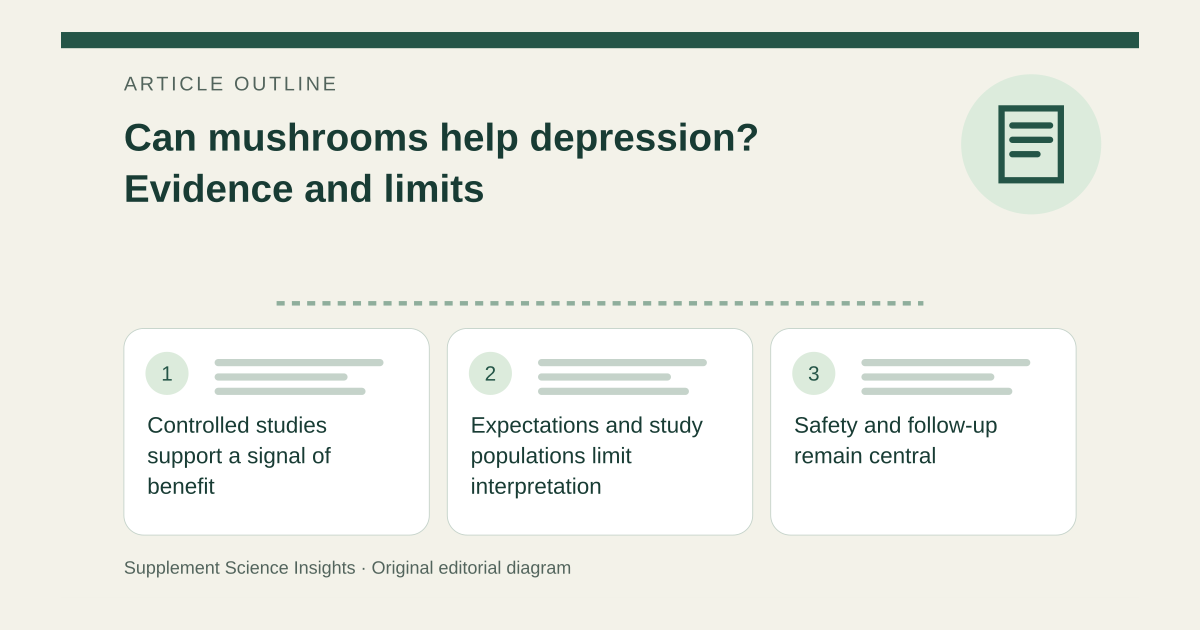
Controlled studies support a signal of benefit
A 2024 systematic review pooled seven studies with 436 participants and found greater improvement in depression scores with psilocybin than comparator treatment. This supports further clinical investigation; it is not evidence that every person benefits or that unsupervised mushrooms reproduce the result. [1]
Expectations and study populations limit interpretation
The review rated the evidence moderate certainty and highlighted expectancy effects, variation in psychological support and limited demographic diversity. Results also differed with depression context and assessment method. Direct comparisons with standard antidepressants require their own trials. [1]
Safety and follow-up remain central
Psilocybin can cause panic, cardiovascular changes and other adverse effects, and is unsuitable for some psychiatric conditions. Do not stop an antidepressant to copy a research protocol. The treating clinician should assess ongoing symptoms, risk and evidence-based alternatives. [2]
Distinguish short-term change from sustained recovery
Imagine mood improves for several days after an experience. That may be meaningful to the person, but it does not establish lasting remission or remove the need for care. Track functioning and symptoms over time with clinical support. [2][1]
| Claim | Needed distinction |
|---|---|
| Improved rating scale | Not universal remission |
| Strong experience | Not a clinical endpoint |
| Trial with support | Different from unsupervised use |
| Short-term improvement | Durability remains relevant |
Sources for this article
- Efficacy of psilocybin for treating symptoms of depression: systematic review and meta-analysis - PMC
Source consulted: 2026-09-21. This is a reference resource, not a claim that we conducted the studies or tested a product. - Psilocybin for Mental Health and Addiction: What You Need To Know | NCCIH
Source consulted: 2026-09-21. This is a reference resource, not a claim that we conducted the studies or tested a product.