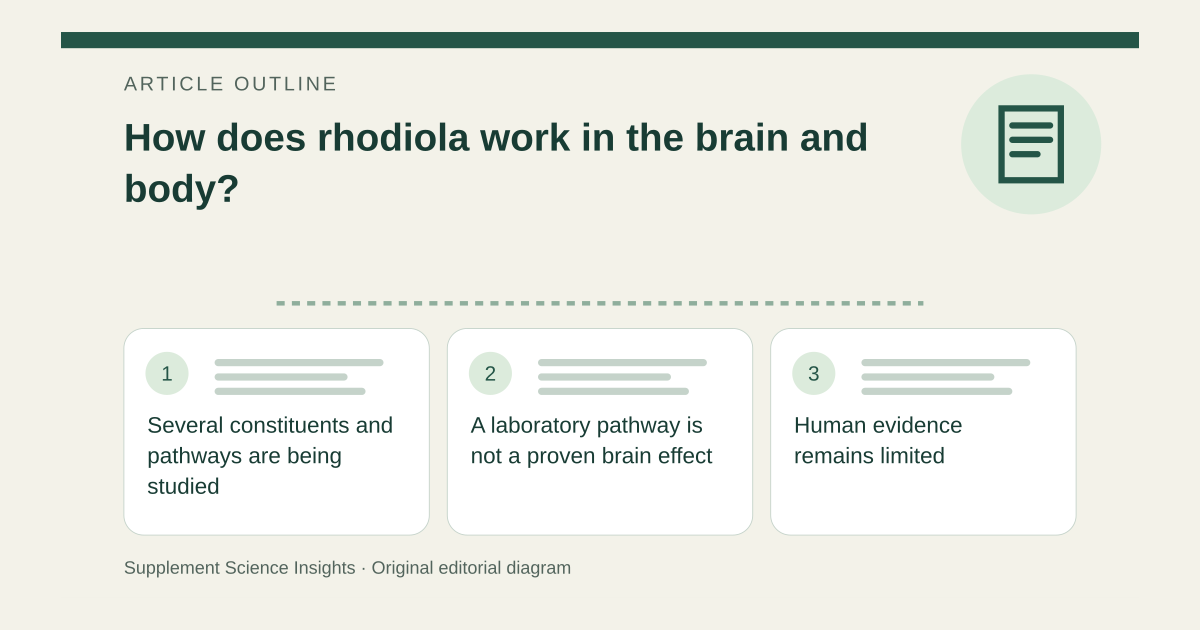
Several constituents and pathways are being studied
MSK describes laboratory findings involving salidroside, antioxidant defenses, nitric-oxide-related pathways and enzymes such as monoamine oxidase. The observed effects depend on the experimental preparation and conditions. [1]
A laboratory pathway is not a proven brain effect
Inhibition of an enzyme in a laboratory does not tell us how much a retail capsule changes neurotransmitters in a living person, whether it reaches the relevant tissue or whether the change produces a useful outcome. Avoid treating a mechanism diagram as a clinical result. [1][2]
Human evidence remains limited
Small or preliminary studies have explored fatigue, stress and performance. NCCIH concludes there is not enough reliable evidence to determine usefulness for health purposes. The term adaptogen does not remove those limitations. [3][1]
Mechanistic uncertainty still permits caution
Imagine someone combines rhodiola with an antidepressant because both are marketed for mood. Possible interactions and reported adverse reactions warrant a pharmacist or prescriber review; uncertain efficacy is not proof that the combination is inactive or harmless. [1]
| Question | Interpretation |
|---|---|
| Laboratory enzyme effect | Research lead |
| Brain chemical balance claim | Not established |
| Small clinical study | Limited generalizability |
| Medicine combination | Review interactions |
Sources for this article
- Rhodiola | Memorial Sloan Kettering Cancer Center
Source consulted: 2026-09-21. This is a reference resource, not a claim that we conducted the studies or tested a product. - Dietary Supplements: What You Need to Know
Source consulted: 2026-09-21. This is a reference resource, not a claim that we conducted the studies or tested a product. - Rhodiola: Usefulness and Safety | NCCIH
Source consulted: 2026-09-21. This is a reference resource, not a claim that we conducted the studies or tested a product.