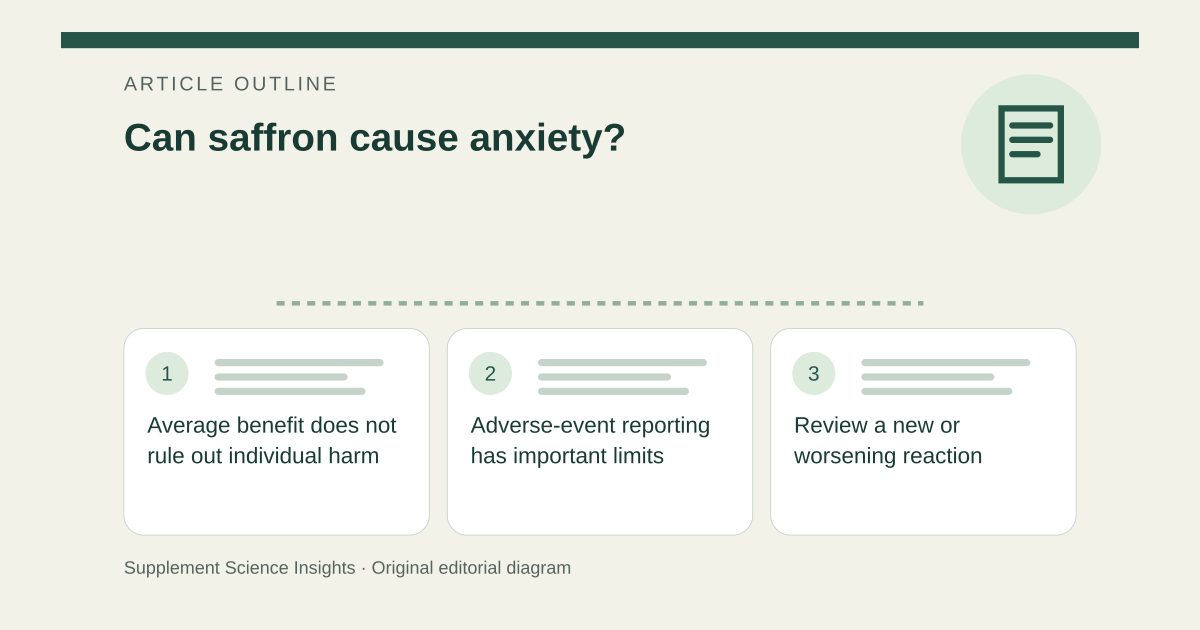
Average benefit does not rule out individual harm
A 2026 meta-analysis found improvement on some self-reported anxiety and depression scales, but not all clinician-rated measures. Those group findings do not guarantee that an individual feels calmer or that every retail extract has the same effects. [1]
Adverse-event reporting has important limits
A separate safety review lists nervousness, irritability, restlessness, anxiety and hypomania among reported psychological events. Reporting varied and causality was not established for every event. Its event counts should not be read as a precise risk for all users. [2]
Review a new or worsening reaction
Stop escalating the supplement and discuss the timing, amount, full ingredients and other medicines with a clinician or pharmacist. Marked agitation, unusually elevated mood or much less need for sleep warrants prompt assessment rather than assuming the supplement is working. [2][3]
Keep treatment changes supervised
Imagine anxiety worsens after adding a saffron blend to prescribed treatment. Do not abruptly stop the prescription to test the supplement. Review the combination and obtain urgent help for severe symptoms or immediate risk of harm. [4][3]
| Finding | Meaning |
|---|---|
| Average trial improvement | Not universal response |
| New restlessness | Review possible reaction |
| Several new ingredients | Cause uncertain |
| Severe mood change | Prompt clinical help |
Sources for this article
- Effect of saffron on depression, anxiety and mood disorder: a GRADE assessed systematic review and meta-analysis of 34 randomized controlled trials.
Source consulted: 2026-09-21. This is a reference resource, not a claim that we conducted the studies or tested a product. - Adverse Events of Saffron (Crocus sativus L.): Systematic Review of Current Evidence - PMC
Source consulted: 2026-09-21. This is a reference resource, not a claim that we conducted the studies or tested a product. - Dietary Supplements: What You Need to Know
Source consulted: 2026-09-21. This is a reference resource, not a claim that we conducted the studies or tested a product. - Treatment - Depression in adults - NHS
Source consulted: 2026-09-21. This is a reference resource, not a claim that we conducted the studies or tested a product.