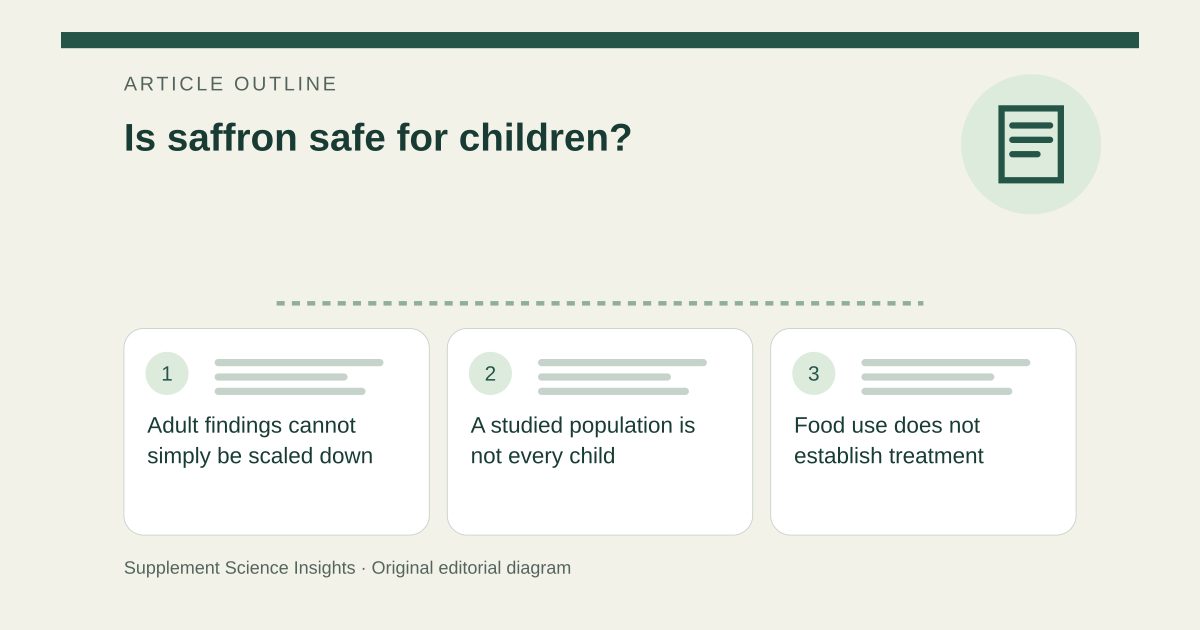
Adult findings cannot simply be scaled down
NCCIH explains that children differ from adults in development and vulnerability to adverse reactions. A fraction of an adult capsule is not automatically a validated child dose. Product quality and other ingredients also matter. [1]
A studied population is not every child
The saffron safety review includes selected clinical populations, including attention-related research, but notes incomplete adverse-event reporting across the literature. Short studies and an absence of reported events do not establish long-term safety in infants or all children. [2]
Food use does not establish treatment
Saffron’s use as a spice does not prove that concentrated daily extracts improve a child’s behavior or mood. A tincture can also introduce alcohol, while blends can contain additional active substances. Check the complete formulation with the clinician. [3][4]
Make the symptom, not the supplement, the starting point
Imagine a child has persistent sleep or attention difficulties. Obtain appropriate assessment and review established options rather than adding an adult mood product. Store all supplements securely to prevent accidental ingestion. [1]
| Question | Why it matters |
|---|---|
| Age and diagnosis | Evidence may not apply |
| Food or extract | Different exposure |
| Other ingredients | Additional risks |
| Long-term use | Safety uncertainty |
Sources for this article
- Children and the Use of Complementary Health Approaches | NCCIH
Source consulted: 2026-09-21. This is a reference resource, not a claim that we conducted the studies or tested a product. - Adverse Events of Saffron (Crocus sativus L.): Systematic Review of Current Evidence - PMC
Source consulted: 2026-09-21. This is a reference resource, not a claim that we conducted the studies or tested a product. - Saffron: World's Most Expensive Spice | University of…
Source consulted: 2026-09-21. This is a reference resource, not a claim that we conducted the studies or tested a product. - Dietary Supplements: What You Need to Know
Source consulted: 2026-09-21. This is a reference resource, not a claim that we conducted the studies or tested a product.