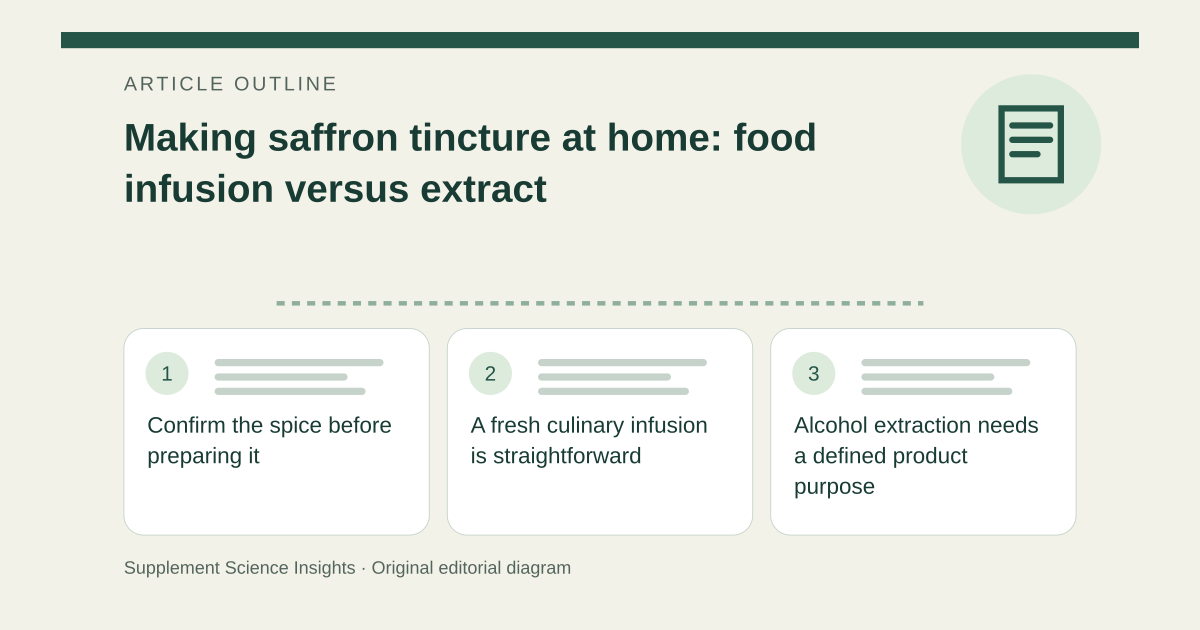
Confirm the spice before preparing it
Use food-grade Crocus sativus stigmas from a traceable source. UCANR warns that toxic Colchicum plants can be confused with saffron crocus. Do not use unidentified flowers, bulbs or other plant parts to make a preparation. [1]
A fresh culinary infusion is straightforward
For a flavor example, place a few saffron threads in a small amount of hot water, let the color and aroma develop and add the liquid to the dish. This is a culinary preparation, not a tested therapeutic exposure or a shelf-stable bottled remedy. [2][3]
Alcohol extraction needs a defined product purpose
A tincture uses an alcohol-containing solvent, but the finished concentration depends on raw material and processing. Do not assume a home jar equals a trial extract, use industrial alcohol or treat dilution as proof that alcohol has been removed. [4]
Choose a labeled preparation when consistency matters
Imagine someone wants a fixed extract amount for a clinician-supervised plan. An untested home tincture cannot supply a verified equivalent. Review the exact product instead, particularly during pregnancy, for children or alongside medicines. [5][6][4]
| Form | Limit |
|---|---|
| Fresh water infusion | Food flavor, variable strength |
| Home tincture | Unverified concentration |
| Diluted tincture | Not necessarily alcohol-free |
| Clinical extract | Defined preparation |
Sources for this article
- Saffron
Source consulted: 2026-09-21. This is a reference resource, not a claim that we conducted the studies or tested a product. - 7 Health Benefits of Saffron
Source consulted: 2026-09-21. This is a reference resource, not a claim that we conducted the studies or tested a product. - Saffron: World's Most Expensive Spice | University of…
Source consulted: 2026-09-21. This is a reference resource, not a claim that we conducted the studies or tested a product. - Dietary Supplements: What You Need to Know
Source consulted: 2026-09-21. This is a reference resource, not a claim that we conducted the studies or tested a product. - Saffron and Pregnancy: Cultural Practices, Beliefs, and Safety Evidence: An Integrative Review - PMC
Source consulted: 2026-09-21. This is a reference resource, not a claim that we conducted the studies or tested a product. - Children and the Use of Complementary Health Approaches | NCCIH
Source consulted: 2026-09-21. This is a reference resource, not a claim that we conducted the studies or tested a product.