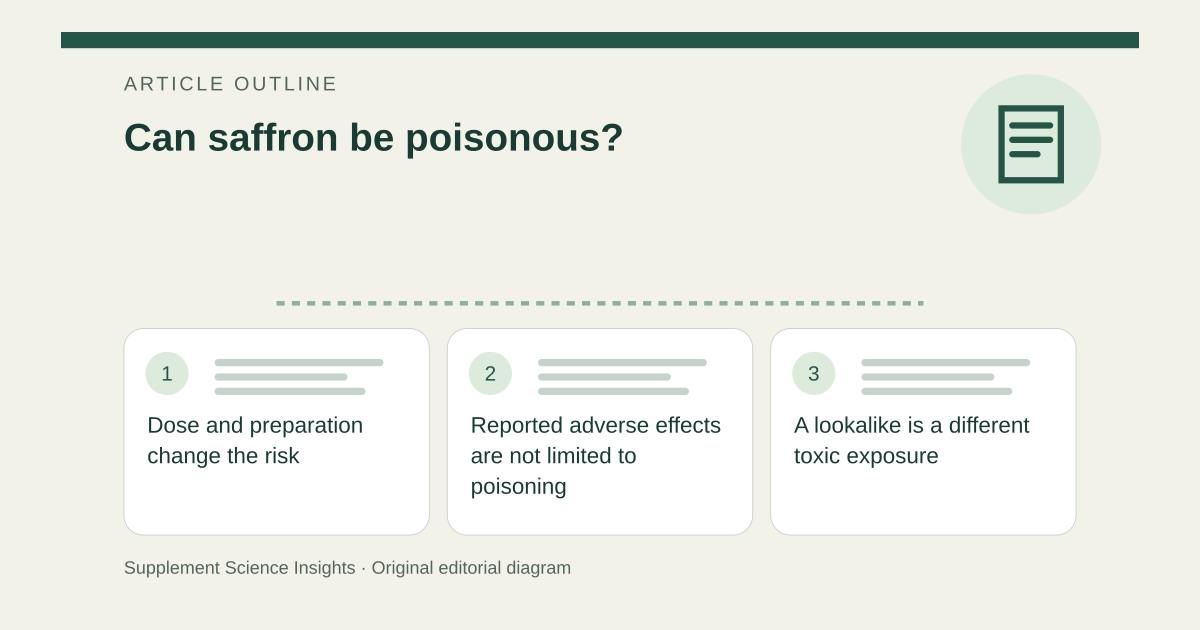
Dose and preparation change the risk
Toxicology reviews distinguish whole saffron from isolated compounds and describe important differences between animal experiments and human data. Those findings do not yield a dependable home threshold for safe use, overdose or fatality. [1]
Reported adverse effects are not limited to poisoning
A human safety review describes digestive and other symptoms and notes incomplete reporting. Larger or prolonged medicinal use deserves caution, while an event reported during a study is not always proven to be caused by saffron. [2]
A lookalike is a different toxic exposure
UCANR warns against confusing Crocus sativus with toxic Colchicum. A plant sold or found as autumn crocus is not automatically the spice. Do not consume unidentified flowers or bulbs, and keep the sample or packaging if exposure occurs. [3]
Get exposure-specific help rather than calculating a threshold
Imagine a child swallows an unknown amount of a saffron supplement or someone eats an unidentified crocus. Contact Poison Control promptly with the product and amount; in the US call 1-800-222-1222. Do not induce vomiting. Collapse, seizure, breathing trouble or inability to wake requires emergency services. [4]
| Detail | Useful action |
|---|---|
| Exact product | Keep packaging |
| Unknown plant | Do not assume saffron |
| Unexpected amount | Poison Control advice |
| Severe symptoms | Emergency services |
Sources for this article
- Toxicology effects of saffron and its constituents: a review - PMC
Source consulted: 2026-09-21. This is a reference resource, not a claim that we conducted the studies or tested a product. - Adverse Events of Saffron (Crocus sativus L.): Systematic Review of Current Evidence - PMC
Source consulted: 2026-09-21. This is a reference resource, not a claim that we conducted the studies or tested a product. - Saffron
Source consulted: 2026-09-21. This is a reference resource, not a claim that we conducted the studies or tested a product. - Poison Control: First aid guidelines
Source consulted: 2026-09-21. This is a reference resource, not a claim that we conducted the studies or tested a product.