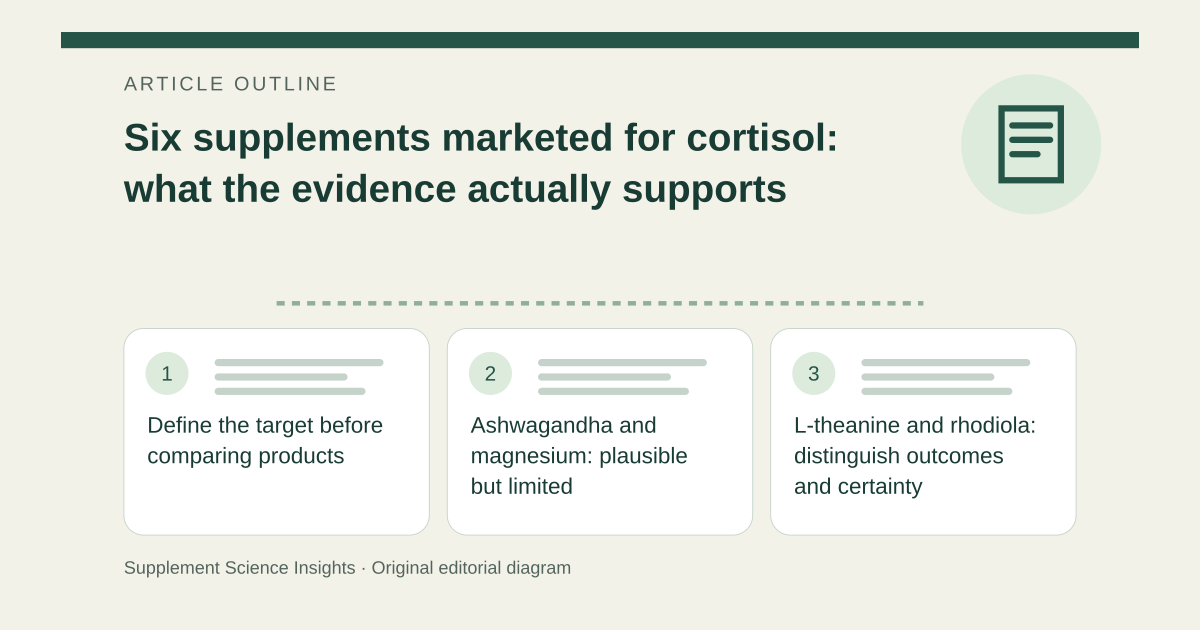
Define the target before comparing products
Cortisol has normal functions and changes with physiological context. NIDDK describes pathological excess as a clinical condition requiring appropriate testing and investigation of its cause. A single value or a feeling of stress does not identify a supplement target, and lower is not always better. [1]
Ashwagandha and magnesium: plausible but limited
NCCIH finds some support for particular ashwagandha preparations in stress or insomnia, with important safety cautions. A magnesium review describes a two-way relationship between stress and nutrient status. Neither establishes an interchangeable product class, a dependable response for everyone or treatment of Cushing syndrome. [2][3]
L-theanine and rhodiola: distinguish outcomes and certainty
A 2026 L-theanine review found only a modest acute stress effect, influenced by studies at high risk of bias; anxiety results were inconsistent. NCCIH considers rhodiola evidence insufficient for a firm health-use conclusion. Feeling calmer, performing differently on a test and lowering cortisol are not the same endpoint. [4][5]
Vitamins C and D: adequacy is not hormone treatment
Vitamin C is an essential nutrient, but its normal functions do not establish a cortisol-lowering prescription. A review of vitamin D and glucocorticoid interactions found limited, heterogeneous clinical evidence. Neither source supports declaring one vitamin the best way to treat an unexplained high cortisol result. [6][7]
Safety can change the choice
Ashwagandha can have liver, thyroid and medicine-related concerns; rhodiola also has adverse effects and reported interactions. If glucocorticoid medicines are involved, the prescriber must guide changes. Do not abruptly stop a steroid medicine or stack multiple stress products in pursuit of a lower number. [2][5][1]
Choose a meaningful outcome
Imagine a person wants better sleep but is shopping for six cortisol blockers. Start by clarifying the sleep problem and whether an endocrine assessment is indicated. Track the symptom that matters rather than assuming that a supplement-induced biomarker change would guarantee better health. [8][1]
| Candidate | Evidence boundary |
|---|---|
| Ashwagandha | Some preparation-specific stress findings |
| Magnesium | Status and stress links; no universal cortisol regimen |
| L-theanine | Modest, bias-sensitive stress findings |
| Rhodiola | Insufficient reliable evidence |
| Vitamin C | Nutritional role is not hormone treatment |
| Vitamin D | Limited heterogeneous glucocorticoid research |
Sources for this article
- Cushing's Syndrome - NIDDK
Source consulted: 2026-09-21. This is a reference resource, not a claim that we conducted the studies or tested a product. - Ashwagandha: Usefulness and Safety | NCCIH
Source consulted: 2026-09-21. This is a reference resource, not a claim that we conducted the studies or tested a product. - Magnesium Status and Stress: The Vicious Circle Concept Revisited - PMC
Source consulted: 2026-09-21. This is a reference resource, not a claim that we conducted the studies or tested a product. - Cognitive and affective effects of L-Theanine: a systematic review and meta-analysis of 31 randomized trials.
Source consulted: 2026-09-21. This is a reference resource, not a claim that we conducted the studies or tested a product. - Rhodiola: Usefulness and Safety | NCCIH
Source consulted: 2026-09-21. This is a reference resource, not a claim that we conducted the studies or tested a product. - Vitamin C - Health Professional Fact Sheet
Source consulted: 2026-09-21. This is a reference resource, not a claim that we conducted the studies or tested a product. - Vitamin D and adrenal gland: Myth or reality? A systematic review - PMC
Source consulted: 2026-09-21. This is a reference resource, not a claim that we conducted the studies or tested a product. - Caring for Your Mental Health - National Institute of Mental Health (NIMH)
Source consulted: 2026-09-21. This is a reference resource, not a claim that we conducted the studies or tested a product.