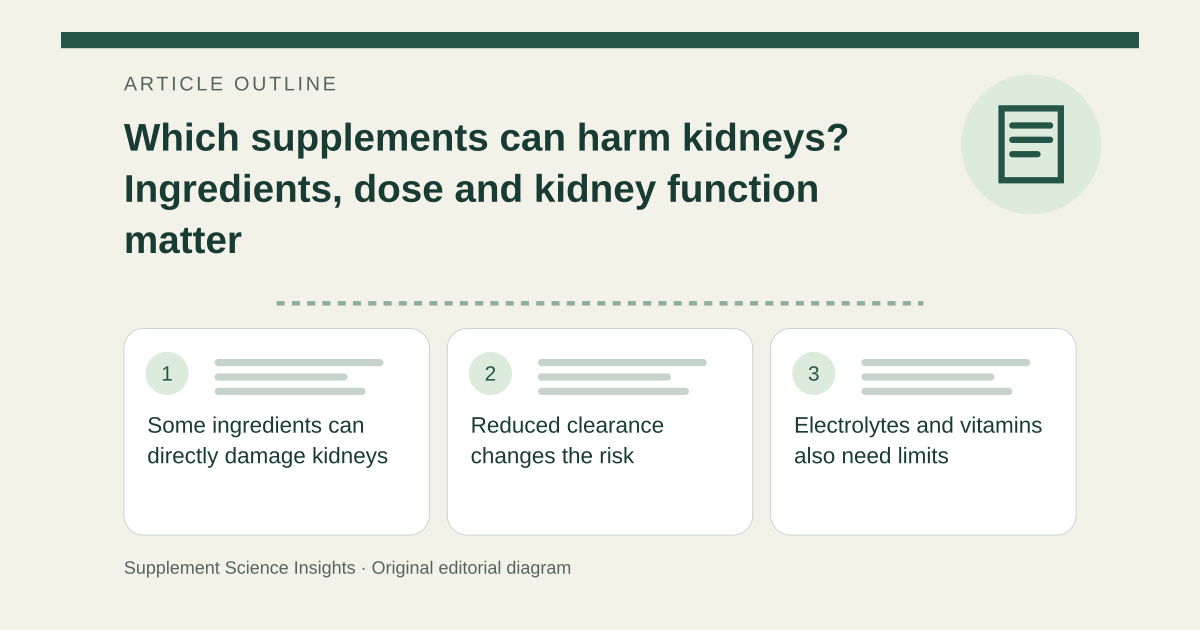
Some ingredients can directly damage kidneys
The National Kidney Foundation identifies aristolochic acid as a known kidney-damaging ingredient that may still occur in some traditional remedies. The botanical identity matters: a familiar common name is not enough to establish the contents or safety of a product. [1]
Reduced clearance changes the risk
Some herbal ingredients leave the body through the kidneys and can accumulate in kidney disease. NKF flags multiple products for particular caution in CKD, including oral aloe, licorice root and creatine. This is not evidence that each produces the same risk in every healthy person. [1]
Electrolytes and vitamins also need limits
Potassium and phosphorus in mineral-rich or greens products may matter when a kidney-care plan limits them. Vitamin selection is also individualized in CKD. A product labeled electrolyte support is not automatically suitable simply because it contains familiar nutrients. [1][2]
A higher creatinine result is not always proof of injury
NKF notes that creatine use can affect blood creatinine independently of filtration. Report the supplement when interpreting a kidney test, but do not use that possibility to dismiss an abnormal result. The clinician must assess the result in context. [3]
Avoid using a cleanse to fix a concerning result
Imagine a person with reduced kidney function adds a detox tea and a high-mineral powder. The combination can add risk rather than restore filtration. Review every ingredient with the kidney team, including the product dose and other medicines, before starting it. [1]
| Concern | Example |
|---|---|
| Directly harmful substance | Aristolochic acid |
| Reduced kidney clearance | Accumulation of some ingredients |
| Mineral load | Potassium or phosphorus when restricted |
Sources for this article
- “Kidney Detox” and Herbal Supplements: What’s Safe and What’s Not | National Kidney Foundation
Source consulted: 2026-09-20. This is a reference resource, not a claim that we conducted the studies or tested a product. - Vitamins and CKD, Dialysis, & Transplant: Safe Choices and Risks | National Kidney Foundation
Source consulted: 2026-09-20. This is a reference resource, not a claim that we conducted the studies or tested a product. - Creatinine | National Kidney Foundation
Source consulted: 2026-09-20. This is a reference resource, not a claim that we conducted the studies or tested a product.