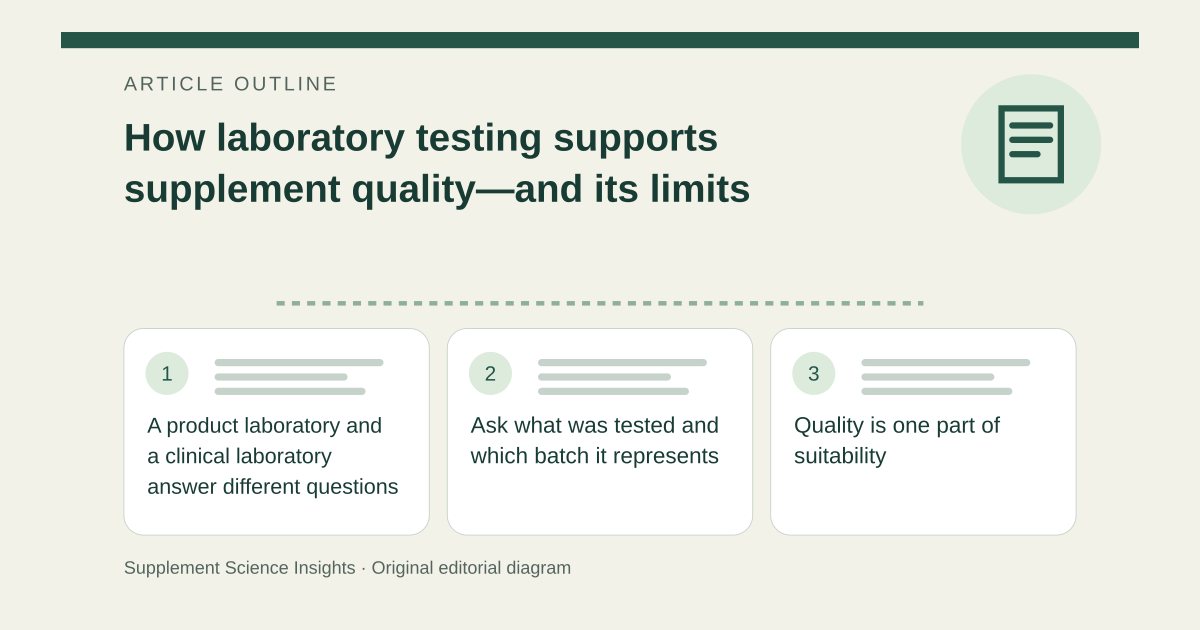
A product laboratory and a clinical laboratory answer different questions
A clinical laboratory tests a patient’s specimen. A supplement-quality laboratory analyzes the product itself. FDA manufacturing requirements address identity, purity, quality, strength and composition; those checks differ from showing that the product improves a clinical outcome. [1]
Ask what was tested and which batch it represents
A report is meaningful only for its sample, method and tested properties. An ingredient-identity result does not automatically answer a heavy-metal question, and a potency result does not establish absence of all contaminants. Check the product name, lot and stated test scope before applying a certificate to your bottle. [1]
Quality is one part of suitability
Imagine a product with a matching batch report but an ingredient that interacts with your medicine. Passing the listed tests would not remove that interaction. Review the full formula and your situation; dietary supplements are not FDA-approved for safety and effectiveness before marketing. [1][2]
| Situation | Next interpretation step |
|---|---|
| Product testing | Assesses the submitted product sample |
| Clinical testing | Assesses a person’s specimen |
| Passing certificate | Limited to the stated checks and batch |
Sources for this article
- Questions and Answers on Dietary Supplements | FDA
Source consulted: 2026-09-20. This is a reference resource, not a claim that we conducted the studies or tested a product. - Dietary Supplements: What You Need to Know
Source consulted: 2026-09-20. This is a reference resource, not a claim that we conducted the studies or tested a product.