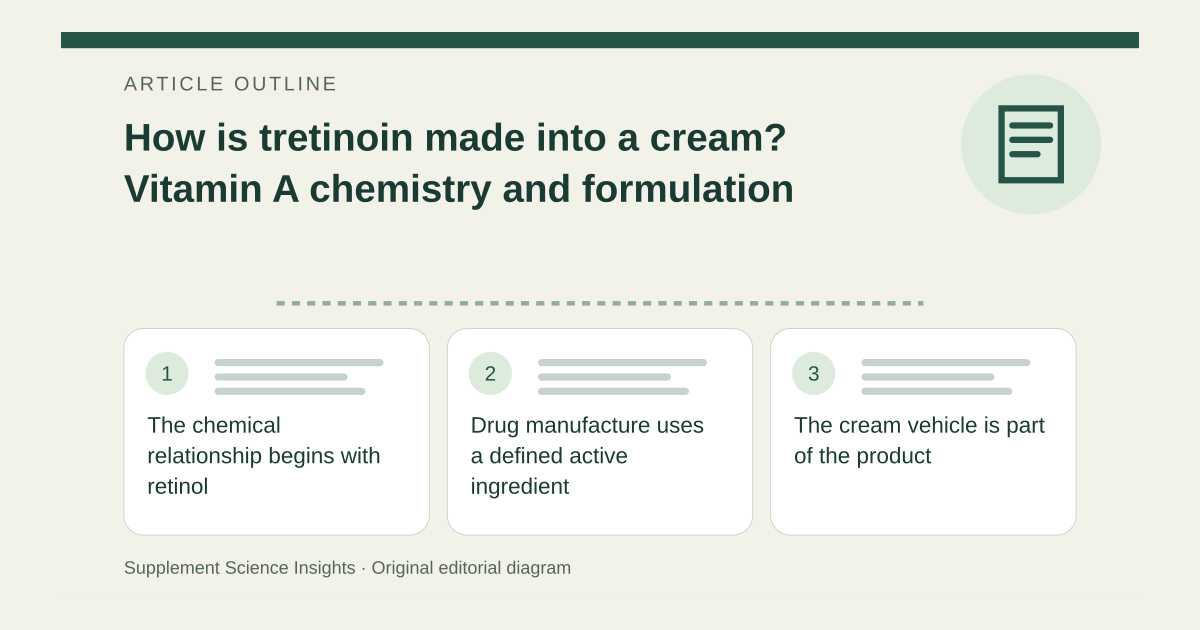
The chemical relationship begins with retinol
A retinoid review describes retinol conversion to retinaldehyde and then retinoic acid through oxidation steps in biological metabolism. Tretinoin is the all-trans form of retinoic acid. Retinol, retinal and tretinoin therefore have related structures but are not identical ingredients or interchangeable concentrations. [1]
Drug manufacture uses a defined active ingredient
The inspected DailyMed label identifies tretinoin as the active ingredient at 0.05% by weight. The public label describes identity and formulation rather than disclosing a complete supplier-specific chemical synthesis. It should not be used to claim that every commercial tube is produced by copying the body’s enzyme pathway. [2]
The cream vehicle is part of the product
That label lists a hydrophilic vehicle containing ingredients such as purified water, stearic acid, stearyl alcohol, an emulsifying ingredient, xanthan gum, sorbic acid and an antioxidant. Together they form the finished dosage form; the active percentage alone does not describe texture, stability or tolerability. Other formulations can differ. [2]
Quality controls matter throughout production
FDA describes drug-manufacturing controls for raw materials, processing, testing and product quality. For a medicine, correct identity, strength and purity are essential. A home mixture does not establish those properties simply because its arithmetic uses the same nominal percentage. Retinoid instability also makes formulation and storage relevant. [3][1]
Interpret the strength without turning it into a recipe
A concentration of 0.05% by weight corresponds to 0.5 mg tretinoin per gram of finished cream. This is an explanation of the label, not preparation instructions. Use the prescribed finished product and its storage directions rather than attempting to convert an oral vitamin capsule into a topical medicine. [2]
| Stage | What it establishes |
|---|---|
| Chemical identity | All-trans-retinoic acid |
| Specified concentration | Amount in the finished product |
| Cream vehicle | Delivery and formulation characteristics |
| Manufacturing controls | Identity, strength, quality and purity |
| Storage and instructions | Appropriate use of that formulation |
Sources for this article
- Use of Retinoids in Topical Antiaging Treatments: A Focused Review of Clinical Evidence for Conventional and Nanoformulations - PMC
Source consulted: 2026-09-21. This is a reference resource, not a claim that we conducted the studies or tested a product. - DailyMed - TRETINOIN cream
Source consulted: 2026-09-21. This is a reference resource, not a claim that we conducted the studies or tested a product. - Facts About the Current Good Manufacturing Practice (CGMP) | FDA
Source consulted: 2026-09-21. This is a reference resource, not a claim that we conducted the studies or tested a product.