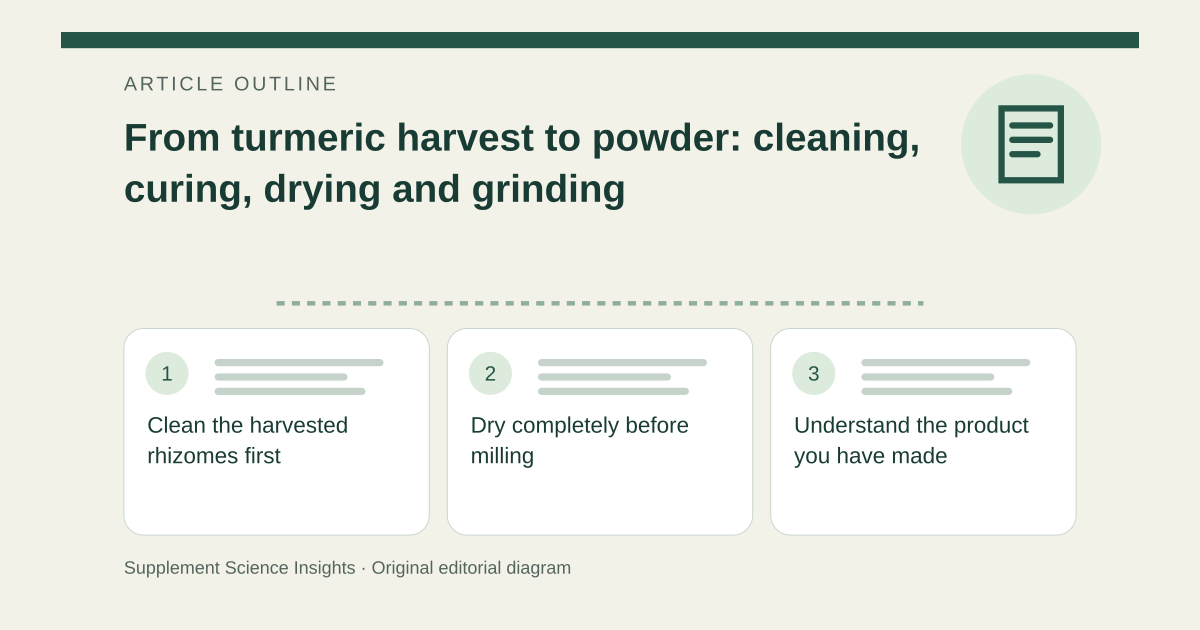
Clean the harvested rhizomes first
Remove adhering soil and wash the rhizomes carefully. NC Cooperative Extension describes a home preparation method that boils turmeric for 45 minutes before drying it. That is one published processing approach, not a claim that every commercial producer uses the same curing conditions. Use sound material and suitable clean equipment. [1]
Dry completely before milling
The extension guidance describes a food dehydrator or a 200°F oven and directs drying until the pieces are very dry. Piece size and equipment affect duration. Cool and grind the dried material, then package it to exclude moisture. Do not infer shelf stability solely because a blender can turn a partly dried rhizome into small particles. [1][2]
Understand the product you have made
Imagine two batches have different color intensity after processing. Appearance alone does not quantify their curcuminoids, which are the characteristic yellow-orange pigments. The finished powders still contain the broader plant material; a gram of homemade powder is not a gram of isolated curcumin. Use it as a culinary ingredient rather than converting it into an untested supplement regimen. [3][4]
| Choice | Practical interpretation |
|---|---|
| Rhizome powder | Processed whole spice |
| Curcumin extract | Different preparation |
| Dry appearance | Must be supported by adequate drying throughout |
Sources for this article
- Ginger and Turmeric: Tropical Superfoods for the Garden - Caldwell County Center | N.C. Cooperative Extension
Source consulted: 2026-09-20. This is a reference resource, not a claim that we conducted the studies or tested a product. - Food Storage Conditions — Utah State University Extension
Source consulted: 2026-09-20. This is a reference resource, not a claim that we conducted the studies or tested a product. - Curcumin | Linus Pauling Institute | Oregon State University
Source consulted: 2026-09-20. This is a reference resource, not a claim that we conducted the studies or tested a product. - Turmeric: Usefulness and Safety | NCCIH
Source consulted: 2026-09-20. This is a reference resource, not a claim that we conducted the studies or tested a product.