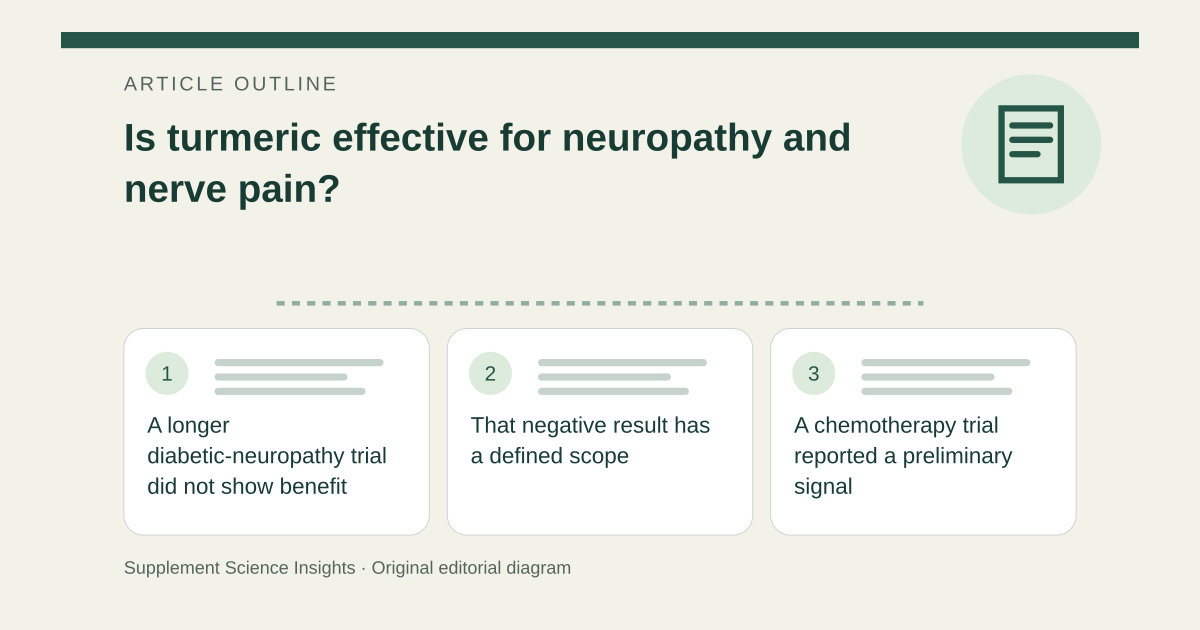
A longer diabetic-neuropathy trial did not show benefit
In a randomized double-blind trial, 97 adults with type 2 diabetes and peripheral neuropathy received a defined nanocurcumin preparation or placebo. The intervention was 40 mg twice daily for sixteen weeks alongside prescribed care. Among the 86 completers, pain and neuropathy examination outcomes did not differ significantly between groups. This was a study regimen, not a recommended self-treatment dose. [1]
That negative result has a defined scope
The main analysis was per protocol; the authors reported a consistent intention-to-treat sensitivity analysis without showing its data. The study excluded several other neuropathy causes and important comorbidities. It was funded by Iran’s National Institute for Medical Research Development, and the authors declared no competing interests. It does not rule out every possible future formulation, but it fails to support benefit from the tested regimen. [1]
A chemotherapy trial reported a preliminary signal
A 2026 trial randomized seventy adults and analyzed sixty-five after four weeks of a defined curcumin product or placebo. It reported improvement in patient-rated sensory symptoms, but not motor or autonomic domains. No objective nerve-function improvement was established. The small sample, short follow-up and selected population limit generalization. [2]
Reporting inconsistencies reduce confidence further
The chemotherapy paper gives conflicting descriptions of participant dropout and of the chemotherapy agents included. These unresolved inconsistencies mean its favorable symptom result should not be treated as robust proof of neuroprotection. A university grant supported the study; the sponsor participated in design and approved the manuscript, and the authors declared no competing interests. [2]
Treat the cause and protect function
Neuropathy care may involve diabetes management, correction of a documented deficiency, review of a causative medicine or treatment of another disorder. Specific nerve-pain medicines may help even when ordinary painkillers do not. Cancer patients should discuss any curcumin product with the oncology team because interaction and treatment context matter. [3][4]
Less pain does not necessarily mean repaired nerves
Imagine tingling becomes less noticeable but weakness or loss of protective sensation persists. Symptom relief alone does not establish regeneration or safe foot function. Continue the clinical assessment and care plan instead of assuming an anti-inflammatory supplement has reversed nerve damage. [3][2]
| Setting | Result and limit |
|---|---|
| Diabetic neuropathy, sixteen weeks | No significant benefit from the tested regimen |
| Chemotherapy neuropathy, four weeks | Preliminary sensory signal; reporting concerns |
| Patient-rated symptoms | Not objective nerve repair |
| Different cause or formula | Cannot assume the same response |
Sources for this article
- The effectiveness and safety of nanocurcumin supplementation for diabetic peripheral neuropathy in patients with type 2 diabetes: a randomized double-blind clinical trial - PMC
Source consulted: 2026-09-21. This is a reference resource, not a claim that we conducted the studies or tested a product. - Curcumin as a neuroprotective agent against platinum-induced peripheral neuropathy: a double-blind randomized clinical trial - PMC
Source consulted: 2026-09-21. This is a reference resource, not a claim that we conducted the studies or tested a product. - Peripheral neuropathy - Treatment - NHS
Source consulted: 2026-09-21. This is a reference resource, not a claim that we conducted the studies or tested a product. - Turmeric | Memorial Sloan Kettering Cancer Center
Source consulted: 2026-09-21. This is a reference resource, not a claim that we conducted the studies or tested a product.