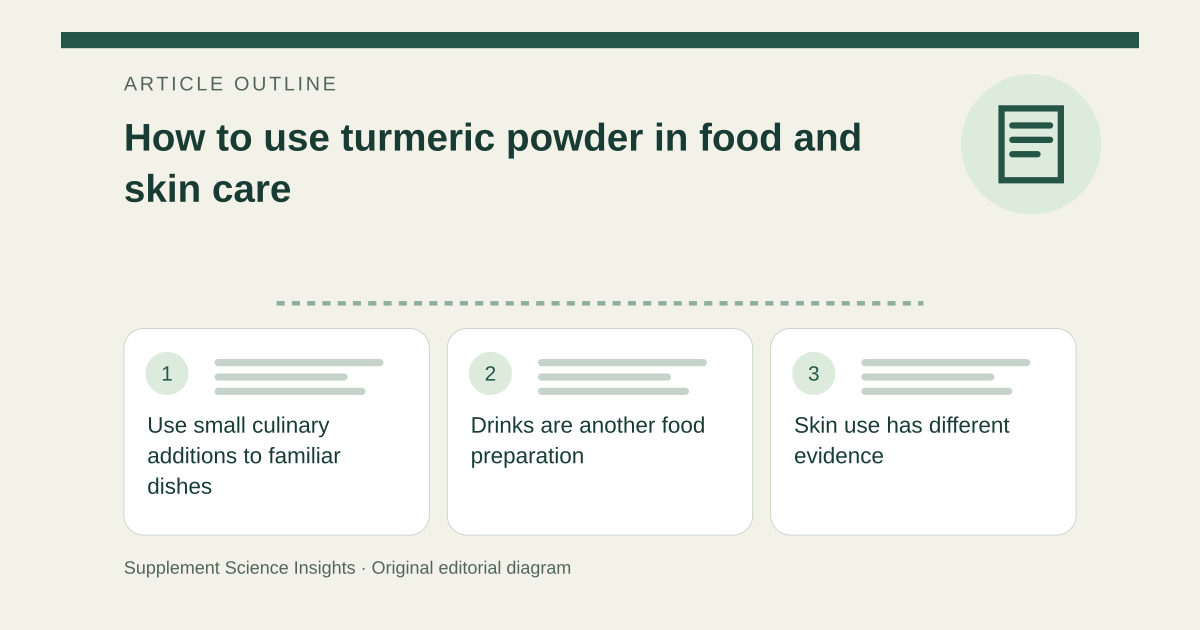
Use small culinary additions to familiar dishes
For original kitchen examples, stir a small pinch into lentil soup, rice, scrambled eggs or a vegetable seasoning blend, then adjust to taste on a later attempt. Follow the underlying recipe for cooking and food safety. Stronger color is not a measure of a therapeutic dose or proof of greater health benefit. [1]
Drinks are another food preparation
A small culinary amount can flavor a warm drink, but sediment and yellow staining are expected practical considerations. A drink made with powder is not equivalent to a concentrated extract. Do not use its color or strength to estimate the dose from a clinical supplement study. [1]
Skin use has different evidence
A dermatology review found studies of defined turmeric or curcumin preparations for several conditions, with evidence varying by diagnosis. It does not validate every homemade mask. NCCIH notes possible itching or hives from topical curcumin; kitchen powder is not a substitute for a formulated treatment for acne or another diagnosed problem. [2][1]
Avoid treating irritation as progress
Use skin-care products according to their directions and test new products on a small area as AAD advises. Wash off and stop a product that causes a reaction. A test for tolerability does not establish that a turmeric mixture treats pigmentation, infection or scarring. [3]
Keep food experiments separate from treatment decisions
Imagine a person enjoys turmeric rice and then assumes a daily powder face mask will have the same safety profile. Swallowing a food amount and prolonged skin contact are different exposures. Assess each use on its own rather than turning familiarity with a spice into a medical conclusion. [1][2]
| Use | Practical approach |
|---|---|
| Cooking | Small seasoning addition to a trusted recipe |
| Drink | Flavor choice, not a treatment dose |
| Skin | Formulation and irritation matter |
| Supplementation | Evidence and safety need separate review |
Sources for this article
- Turmeric: Usefulness and Safety | NCCIH
Source consulted: 2026-09-21. This is a reference resource, not a claim that we conducted the studies or tested a product. - Evaluation of curcumin for dermatologic conditions: a systematic review.
Source consulted: 2026-09-21. This is a reference resource, not a claim that we conducted the studies or tested a product. - How to test skin care products
Source consulted: 2026-09-21. This is a reference resource, not a claim that we conducted the studies or tested a product.