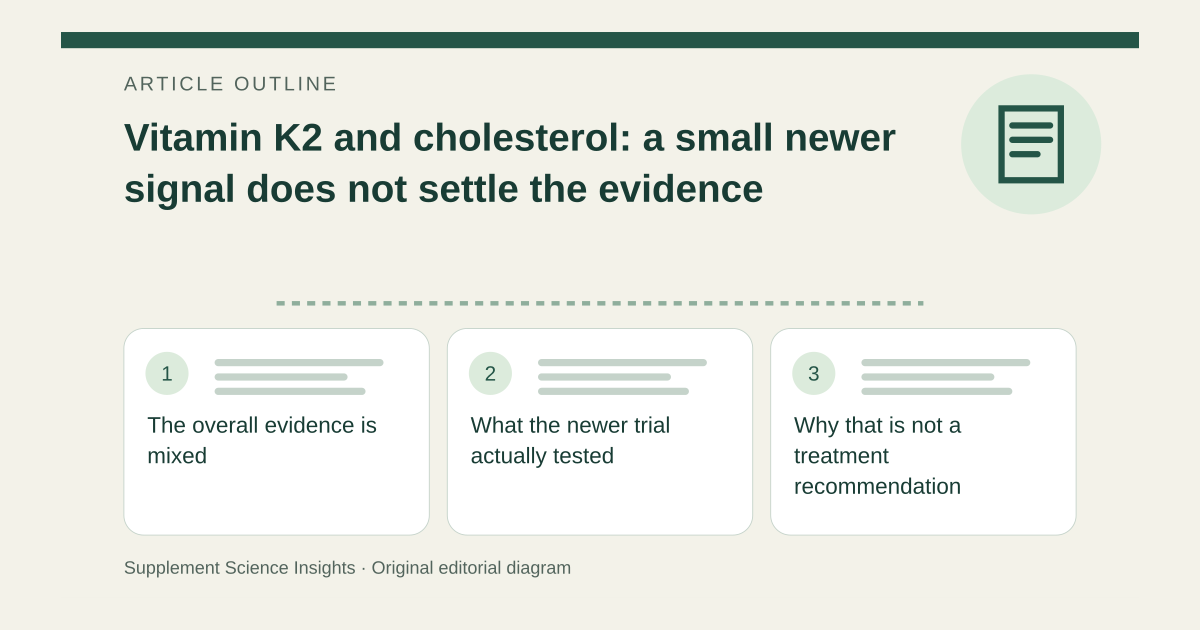
The overall evidence is mixed
A systematic review of 17 randomized trials did not find significant pooled effects on total cholesterol, LDL, HDL or triglycerides. Forms, doses and participants differed. This makes a blanket claim that all K2 products lower cholesterol stronger than the evidence supports. [1]
What the newer trial actually tested
A 2026 randomized double-blind trial assigned young Mexican adults with overweight or obesity to 100 mcg daily MK-4 or placebo for 12 weeks, with nutritional counseling in both groups. Of 51 enrolled participants, 46 completed the intervention. The paper reported statistically favorable between-group total and LDL cholesterol findings, but not a significant body-composition effect. [2]
Why that is not a treatment recommendation
The study was small and short, and its primary carboxylated-osteocalcin outcome did not improve. Some baseline dietary-table entries appear inconsistent. The authors reported no external funding or conflicts. These limits, together with the older pooled findings, support further research rather than a dependable cholesterol-lowering promise. [2][1]
Lipid changes are not cardiovascular-event results
The trial did not demonstrate prevention of heart attacks or strokes. Cholesterol care depends on the lipid pattern and overall cardiovascular risk, using appropriate food, activity and medicines when indicated. Do not replace a prescription or delay follow-up because of an ingredient claim. [3][2]
Keep the form and medicine context attached
Imagine a trial of MK-4 is used to advertise a different MK-7 blend. That does not establish equivalent results. Vitamin K also has an important interaction with warfarin, so discuss any proposed product with the treatment team. [4][2]
| Question | Why it matters |
|---|---|
| MK-4 or another form? | The preparation must match |
| Blood marker or clinical event? | They are different outcomes |
| One trial or pooled evidence? | Consistency matters |
| Taking warfarin? | Do not change vitamin K intake casually |
Sources for this article
- The effect of vitamin K supplementation on cardiovascular risk factors: a systematic review and meta-analysis - PMC
Source consulted: 2026-09-21. This is a reference resource, not a claim that we conducted the studies or tested a product. - Vitamin K2 Supplementation Reduces Cardiometabolic Risk Factors in Young Adults with Overweight and Obesity—A Randomized Placebo-Controlled Trial - PMC
Source consulted: 2026-09-21. This is a reference resource, not a claim that we conducted the studies or tested a product. - Cholesterol Management at a Glance | NCCIH
Source consulted: 2026-09-21. This is a reference resource, not a claim that we conducted the studies or tested a product. - Vitamin K - Health Professional Fact Sheet
Source consulted: 2026-09-21. This is a reference resource, not a claim that we conducted the studies or tested a product.