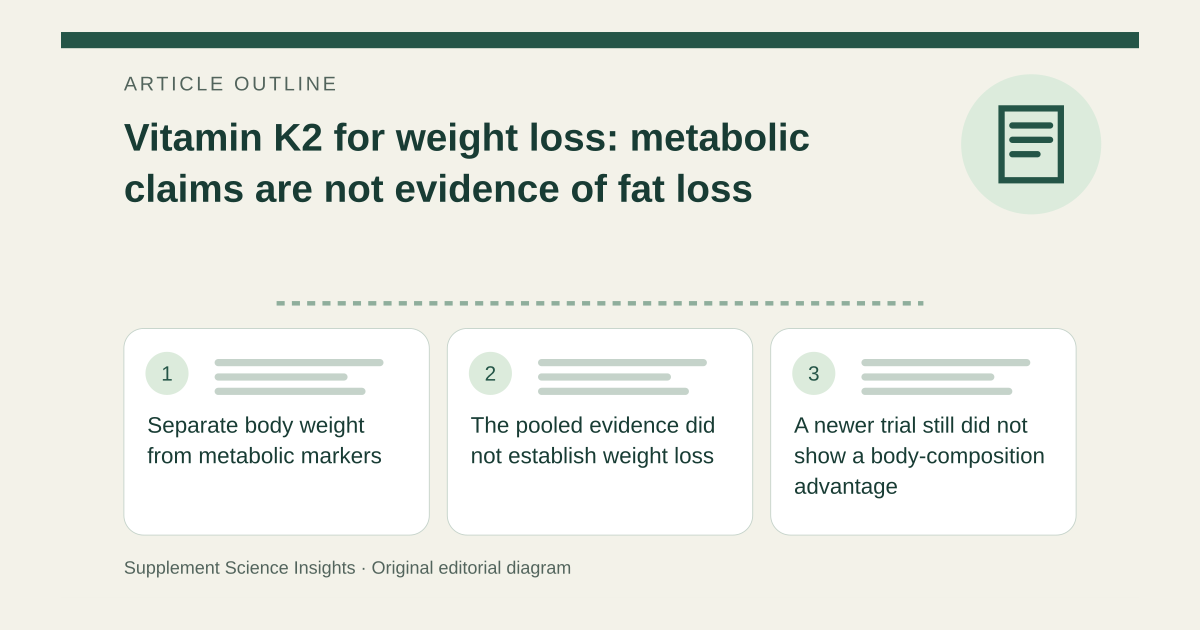
Separate body weight from metabolic markers
A supplement can affect a laboratory measure without reducing body fat or improving weight-related health outcomes. The reviewed vitamin K literature includes different forms and populations, so a result for one marker should not become a general fat-burning claim. [1]
The pooled evidence did not establish weight loss
A systematic review of 17 randomized trials found no significant pooled change in weight or other anthropometric measures. It reported a signal for an insulin-resistance measure, but that is a different outcome. Mixed populations and preparations also limit claims for a specific retail K2 product. [1]
A newer trial still did not show a body-composition advantage
A 2026 double-blind trial enrolled 51 Mexican adults aged 18–35 with overweight or obesity; 46 completed it. Participants received MK-4 at 100 mcg daily or placebo for 12 weeks, and both groups received nutritional counseling. BMI, waist circumference and fat measures did not show significant between-group improvements. The study dose is a research detail, not a weight-loss prescription. [2]
Keep the trial’s limits visible
The trial was small, short and limited to younger adults without known comorbidities. Its primary vitamin K-dependent protein outcome did not improve. The report declared no external funding or conflicts; apparent inconsistencies in its baseline dietary table add caution. It cannot establish a long-term weight-management benefit. [2]
Do not buy a weight-loss promise from a cholesterol result
Imagine a product advertises the newer trial’s favorable lipid findings as proof of fat loss. Those are different endpoints. Review the actual goal and remember that vitamin K can interfere with warfarin; a metabolic claim does not establish suitability. [2][3]
| Finding | What it establishes |
|---|---|
| Changed laboratory marker | That marker, not automatic fat loss |
| No body-composition difference | No demonstrated benefit on that outcome |
| One short trial | Limited long-term inference |
| Warfarin use | Specific interaction review needed |
Sources for this article
- The effect of vitamin K supplementation on cardiovascular risk factors: a systematic review and meta-analysis - PMC
Source consulted: 2026-09-21. This is a reference resource, not a claim that we conducted the studies or tested a product. - Vitamin K2 Supplementation Reduces Cardiometabolic Risk Factors in Young Adults with Overweight and Obesity—A Randomized Placebo-Controlled Trial - PMC
Source consulted: 2026-09-21. This is a reference resource, not a claim that we conducted the studies or tested a product. - Vitamin K - Health Professional Fact Sheet
Source consulted: 2026-09-21. This is a reference resource, not a claim that we conducted the studies or tested a product.