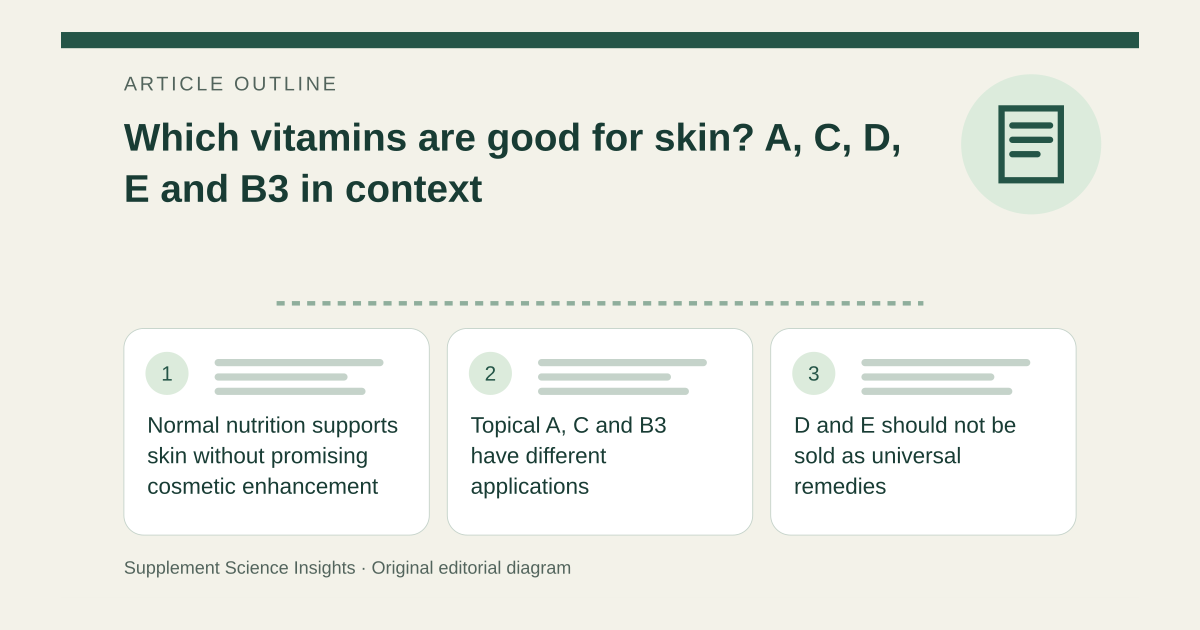
Normal nutrition supports skin without promising cosmetic enhancement
Vitamin C is necessary for collagen synthesis, while vitamin A contributes to normal cellular development and vitamin E has antioxidant functions. Correcting deficiency is important. Increasing an already adequate intake does not automatically erase wrinkles, scars or pigment. [1][2][3]
Topical A, C and B3 have different applications
AAD includes retinoids and vitamin C among options for dark spots. DermNet describes niacinamide effects on barrier function, hydration and pigmentation. These are formulation-specific uses; they do not mean every oral product with the same vitamin name has the same effects. [4][5]
D and E should not be sold as universal remedies
Vitamin D has roles in normal physiology, while high-dose D can cause toxicity. Vitamin E’s nutritional role does not establish routine topical use for scars: a systematic review found insufficient evidence for that practice. Evaluate the specific concern rather than selecting one vitamin for all skin problems. [6][7]
More ingredients can mean more irritation or excess
Combining multiple cosmetic actives can irritate skin, and stacking oral products can increase nutrient exposure. AAD emphasizes cause-specific care and caution with beauty supplements. A simple tolerated routine and adequate diet can be more useful than an expanding list of vitamin products. [4][8]
Match the outcome to the product
Imagine one person wants to improve dryness and another has a changing pigmented lesion. Their needs are different even if both ask for a skin vitamin. Choose barrier care for the first concern and professional assessment for the second rather than assigning both the same supplement. [5][4]
| Vitamin | Useful distinction |
|---|---|
| A | Retinoids are specific topical treatments |
| C | Collagen nutrition differs from a topical pigment product |
| B3 | Niacinamide can support the topical barrier |
| D and E | Adequacy does not prove a cosmetic treatment effect |
Sources for this article
- Vitamin C - Health Professional Fact Sheet
Source consulted: 2026-09-21. This is a reference resource, not a claim that we conducted the studies or tested a product. - Vitamin A and Carotenoids - Health Professional Fact Sheet
Source consulted: 2026-09-21. This is a reference resource, not a claim that we conducted the studies or tested a product. - Vitamin E - Health Professional Fact Sheet
Source consulted: 2026-09-21. This is a reference resource, not a claim that we conducted the studies or tested a product. - How to fade dark spots in darker skin tones
Source consulted: 2026-09-21. This is a reference resource, not a claim that we conducted the studies or tested a product. - Nicotinamide
Source consulted: 2026-09-21. This is a reference resource, not a claim that we conducted the studies or tested a product. - Vitamin D - Health Professional Fact Sheet
Source consulted: 2026-09-21. This is a reference resource, not a claim that we conducted the studies or tested a product. - The Role of Topical Vitamin E in Scar Management: A Systematic Review.
Source consulted: 2026-09-21. This is a reference resource, not a claim that we conducted the studies or tested a product. - Should I take vitamins or supplements for my skin?
Source consulted: 2026-09-21. This is a reference resource, not a claim that we conducted the studies or tested a product.