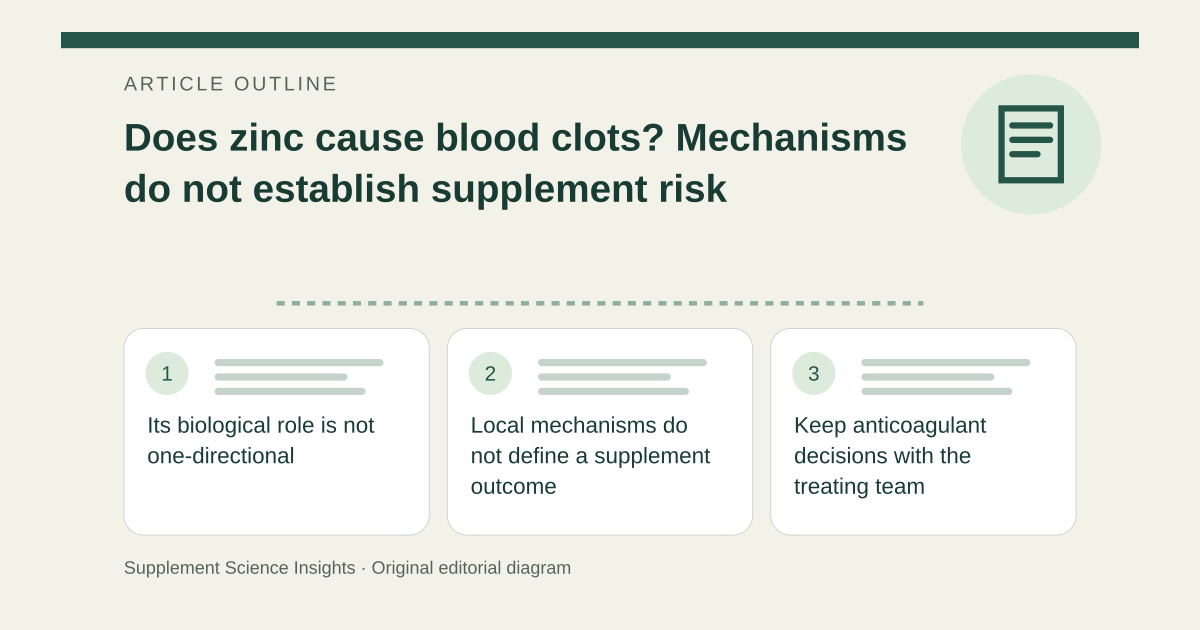
Its biological role is not one-directional
The reviewed research describes zinc effects on coagulation, platelet activity, anticoagulation and clot breakdown. Local zinc concentrations near activated platelets can influence these processes. This is more complex than saying zinc simply thickens or thins the blood. [1]
Local mechanisms do not define a supplement outcome
A mechanistic paper does not establish how a particular oral supplement changes the rate of deep-vein thrombosis or pulmonary embolism. Its findings cannot supply a preventive dose or show that routine intake is the cause of an individual clot. [1]
Keep anticoagulant decisions with the treating team
Do not stop a prescribed blood thinner or use zinc to replace it. Review the full supplement label with a pharmacist, especially combination products. Warfarin has important medicine and nutrient interactions, and the complete regimen matters. [2][3]
Recognize possible clot symptoms
NHS advises urgent assessment for suspected DVT, such as one-sided leg pain and swelling. If those symptoms occur with chest pain or shortness of breath, seek emergency care because a clot may have traveled to the lungs. Do not wait to see whether stopping a supplement fixes it. [4]
Separate a risk review from a causal conclusion
Imagine a clot occurs while someone is taking zinc. Clinicians assess the event and relevant risk factors; coincidence alone does not identify a cause. Still disclose the supplement and dose, since the full health and medicine history is useful. [4][3]
| Evidence | Limit |
|---|---|
| Platelet or protein mechanism | Not an oral-supplement event rate |
| Clot during supplement use | Timing alone does not prove causation |
| Zinc deficiency concern | Separate nutritional assessment |
| Suspected DVT or pulmonary embolism | Prompt clinical care |
Sources for this article
- Zinc: an important cofactor in haemostasis and thrombosis.
Source consulted: 2026-09-21. This is a reference resource, not a claim that we conducted the studies or tested a product. - Warfarin: medicine used to prevent and treat blood clots - NHS
Source consulted: 2026-09-21. This is a reference resource, not a claim that we conducted the studies or tested a product. - Zinc - Health Professional Fact Sheet
Source consulted: 2026-09-21. This is a reference resource, not a claim that we conducted the studies or tested a product. - DVT (deep vein thrombosis) - NHS
Source consulted: 2026-09-21. This is a reference resource, not a claim that we conducted the studies or tested a product.