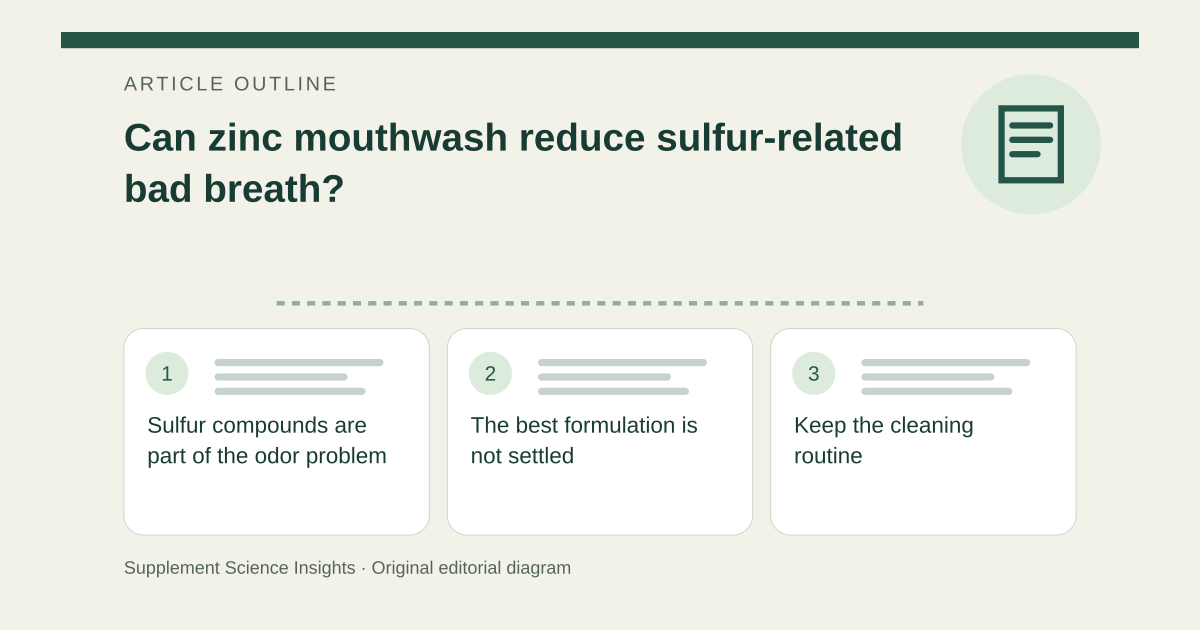
Sulfur compounds are part of the odor problem
The ADA identifies volatile sulfur compounds as major contributors to oral malodor and includes zinc salts among agents used to inhibit odor-causing compounds. This is a formulation-specific oral-care use, not evidence that swallowing zinc tablets will have the same effect. [1]
The best formulation is not settled
A Cochrane review found low or very low certainty across bad-breath interventions and could not determine which worked best. Evidence for a chlorhexidine-plus-zinc-acetate rinse was very uncertain. A plausible ingredient mechanism should not be presented as proof of permanent odor elimination. [2]
Keep the cleaning routine
NHS recommends twice-daily fluoride brushing, daily tongue cleaning and cleaning between teeth, along with dental checks. A mouthrinse can be an addition, not a substitute. Follow product directions and dental advice on timing, especially around fluoride toothpaste. [3][1]
Persistent breath needs a cause assessment
Gum or tooth problems, dry mouth and other conditions can contribute. NHS recommends seeing a dentist when bad breath continues despite self-care for a few weeks or accompanies painful, bleeding or swollen gums, toothache or loose adult teeth. Masking odor can leave those causes untreated. [3]
Choose an oral product rather than mixing salts
Imagine a rinse briefly improves odor but gum bleeding continues. Continue appropriate cleaning and arrange dental assessment. Do not make a concentrated zinc solution from supplement powder: an ingredient name does not provide a tested mouthrinse formulation or instructions. [3][1]
| Observation | Limit |
|---|---|
| Zinc-containing rinse helps briefly | Does not identify or remove every cause |
| Gum bleeding remains | Dental assessment needed |
| Supplement contains zinc | Not a mouthrinse recipe |
| Product has directions | Follow its intended oral use |
Sources for this article
- Mouthrinse (Mouthwash) | American Dental Association
Source consulted: 2026-09-21. This is a reference resource, not a claim that we conducted the studies or tested a product. - Interventions for managing bad breath | Cochrane
Source consulted: 2026-09-21. This is a reference resource, not a claim that we conducted the studies or tested a product. - Bad breath - NHS
Source consulted: 2026-09-21. This is a reference resource, not a claim that we conducted the studies or tested a product.