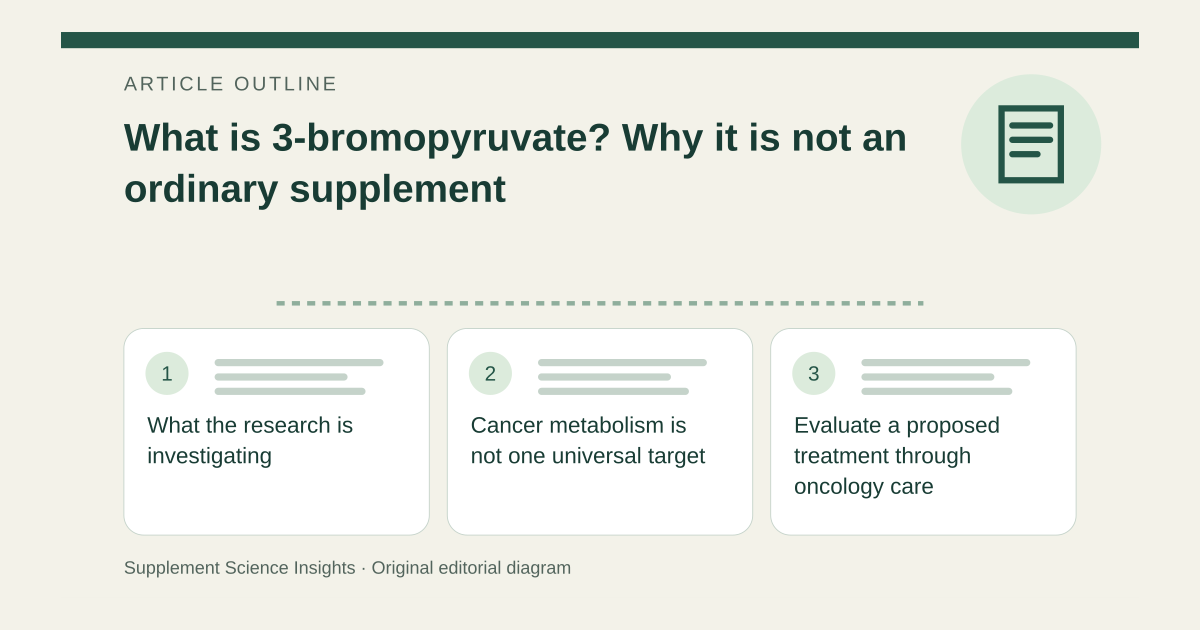
What the research is investigating
A review describes 3-bromopyruvate as an alkylating agent affecting glycolysis and mitochondrial energy production. Much of the antitumor evidence summarized comes from cultured cells and tumor-bearing animals. Those experiments investigate a therapeutic possibility; they do not show that taking the substance improves survival in people. [1]
Cancer metabolism is not one universal target
NCI describes several altered metabolic pathways and the ability of cancer cells to adapt. A compound affecting an energy pathway may also require careful evaluation of delivery, toxicity and tumor context. The phrase starves cancer is too broad to establish a clinically useful treatment. [2]
Evaluate a proposed treatment through oncology care
Imagine a seller cites a dramatic cell-culture result. Ask whether a controlled human study matches the tumor type, formulation and outcome being promised. The inspected review does not establish a self-use dose or justify replacing cancer treatment. Discuss experimental therapies and appropriate trials with the oncology team. [1][3]
| Claim | What it establishes |
|---|---|
| Mechanism or product name | A question to investigate |
| Matching human outcome | Evidence needed for a benefit claim |
| Individual suitability | Requires the actual formulation and context |
Sources for this article
- Tumor Energy Metabolism and Potential of 3-Bromopyruvate as an Inhibitor of Aerobic Glycolysis: Implications in Tumor Treatment.
Source consulted: 2026-09-21. This is a reference resource, not a claim that we conducted the studies or tested a product. - DCB - Cancer Cell Biology Research - NCI
Source consulted: 2026-09-21. This is a reference resource, not a claim that we conducted the studies or tested a product. - Questions and Answers on Dietary Supplements | FDA
Source consulted: 2026-09-21. This is a reference resource, not a claim that we conducted the studies or tested a product.