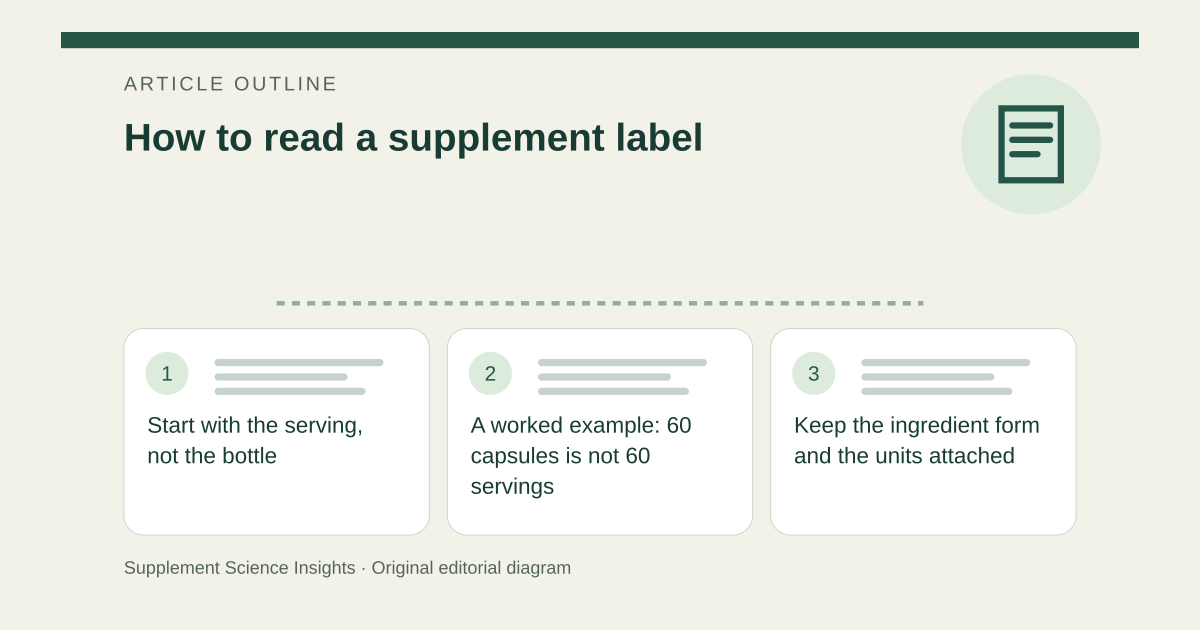
Start with the serving, not the bottle
Before comparing two labels, establish what one serving means. A capsule, scoop and serving are not necessarily the same unit. Locate the serving size and the quantity stated per serving, then read the directions separately. This guide is about interpreting the label, not deciding what you should take. [1]
For a useful comparison, write down four fields together: ingredient, form, amount and serving size. A large number on the front of a container is hard to interpret without those details. [1]
A worked example: 60 capsules is not 60 servings
The example below is fictional. Ingredient X is not a real supplement recommendation, and the numbers are chosen only to demonstrate arithmetic. Assume that all capsules contain the same amount.
Two capsules provide 200 mg, so one capsule provides 100 mg. Sixty capsules divided by two capsules per serving gives 30 servings. A second bottle advertising 100 mg per capsule could therefore supply the same amount per two-capsule serving. That calculation says nothing about whether either product is effective, safe or appropriate.
| Label field | Example | What follows |
|---|---|---|
| Serving size | 2 identical capsules | One serving uses two capsules |
| Amount per serving | 200 mg of ingredient X | 100 mg per capsule |
| Container quantity | 60 capsules | 30 labeled servings |
| Clinical benefit | Not provided | Cannot be calculated from the label |
Keep the ingredient form and the units attached
The form can appear beside the ingredient name or in parentheses. For a mineral, the quantity of the mineral and the weight of the compound supplying it are different concepts. FDA’s guide illustrates this distinction with calcium supplied by calcium carbonate. Avoid comparing a compound weight with a nutrient amount as though the two numbers meant the same thing. [1][3]
Daily Value percentages provide a labeling reference. They are not an individualized prescription and do not measure the probability of benefit. An ingredient without an established Daily Value is not automatically ineffective or unsafe; the label simply does not provide that reference percentage. [1][3]
What a proprietary blend does not tell you
A proprietary blend can identify its constituents while giving a combined quantity instead of each ingredient’s amount. Record that missing information as unknown. Do not divide the total by the number of listed ingredients and present the result as their actual amounts. [2]
For example, a fictional 600 mg blend with three ingredients does not establish that each contributes 200 mg. Equal division is one possible composition among many. If a claim depends on a specific ingredient quantity, the undisclosed breakdown prevents that comparison from being completed. [2]
Read beyond the facts panel
Other ingredients can include materials used in the capsule, flavoring or processing. They should not be confused with the declared dietary ingredients. Read the full ingredient list and the warnings rather than judging a product only by its front panel. [2]
Keep a copy of the exact label version when documenting a product. Write “not disclosed on the inspected label” when a necessary detail is absent; do not fill the gap with a similar bottle, an older photograph or another strength from the same brand. [2]
Finish with a question the label cannot answer
A label is a starting point for checking a claim. It does not by itself establish that the product improves an outcome in people like you. Quality testing, clinical evidence and individual suitability answer different questions. [3]
A useful final note has two parts: what the inspected label states, and what remains unverified. For example: “The serving is two capsules; the exact quantity of ingredient Y inside the blend is not disclosed.” That is more informative than an unsupported pass/fail score. [3]
If you are considering a supplement alongside medicines or for a medical condition, discuss the specific product with a qualified health professional. The arithmetic in this guide should not be used to choose or change a dose. [3]
Sources for this article
- FDA — Dietary Supplement Labeling Guide, Chapter IV
Source consulted: 2026-09-17. This is a reference resource, not a claim that we conducted the studies or tested a product. - FDA — Questions and Answers on Dietary Supplements
Source consulted: 2026-09-17. This is a reference resource, not a claim that we conducted the studies or tested a product. - NIH ODS — Dietary Supplements: What You Need to Know
Source consulted: 2026-09-17. This is a reference resource, not a claim that we conducted the studies or tested a product.