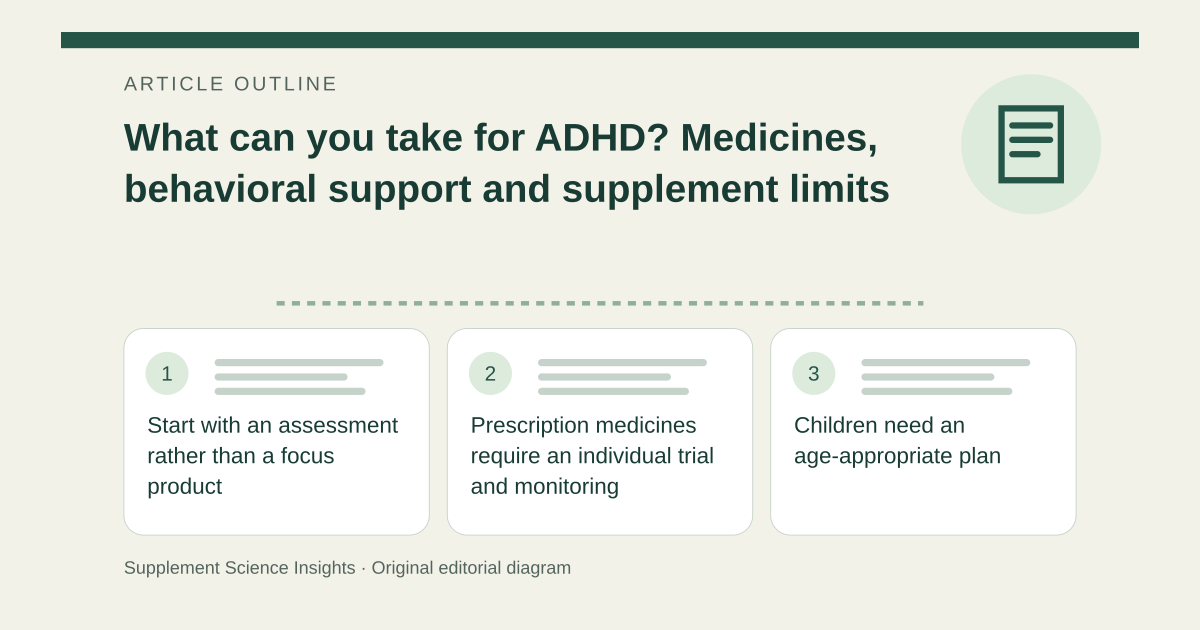
Start with an assessment rather than a focus product
Attention problems can coexist with sleep difficulties, anxiety, learning problems or other conditions. NIMH emphasizes the complexity of ADHD assessment and care. A retail supplement label cannot determine which problem is causing difficulty or select the appropriate treatment. [1]
Prescription medicines require an individual trial and monitoring
CDC describes stimulant and nonstimulant medication options. Clinicians may need to adjust the medicine or dose to balance benefit and adverse effects, including appetite and sleep problems. These are supervised treatment decisions, not interchangeable over-the-counter choices. [2]
Children need an age-appropriate plan
For children younger than six, CDC summarizes parent training in behavior management as the initial approach before medication is tried. School-age care commonly combines medication with behavioral and school support. An adult treatment routine should not be copied for a young child. [2]
Supplement evidence does not justify a replacement claim
NCCIH describes uncertainty about omega-3 benefits and limited or unconvincing evidence for several herbs and other supplements. A natural label does not eliminate interactions. Discuss the exact product with the treating clinician, particularly when prescribed medicines are already used. [3]
Track the outcome that matters
Imagine a product helps a person feel sleepier at night. That is not automatically evidence that it improves daytime ADHD symptoms, school function or work performance. Define the target and review benefits and harms within the full treatment plan. [4][2]
| Question | Useful distinction |
|---|---|
| Prescription option | Monitor benefit and adverse effects |
| Young child | Age-specific behavioral care |
| Supplement claim | Requires ADHD-specific evidence |
Sources for this article
- Attention-Deficit/Hyperactivity Disorder (ADHD) - National Institute of Mental Health (NIMH)
Source consulted: 2026-09-20. This is a reference resource, not a claim that we conducted the studies or tested a product. - Treatment of ADHD | Attention-Deficit / Hyperactivity Disorder (ADHD) | CDC
Source consulted: 2026-09-20. This is a reference resource, not a claim that we conducted the studies or tested a product. - Attention-Deficit Hyperactivity Disorder at a Glance | NCCIH
Source consulted: 2026-09-20. This is a reference resource, not a claim that we conducted the studies or tested a product. - Dietary Supplements: What You Need to Know
Source consulted: 2026-09-20. This is a reference resource, not a claim that we conducted the studies or tested a product.