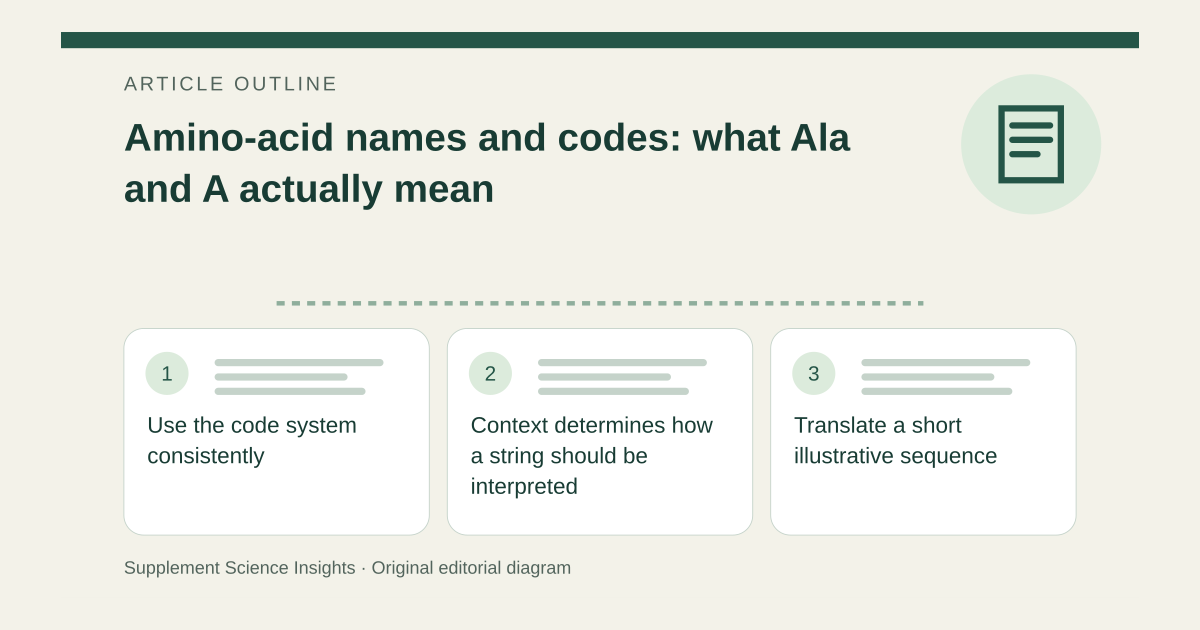
Use the code system consistently
In the textbook table, alanine is Ala or A, asparagine is Asn or N, glutamine is Gln or Q, histidine is His or H, and lysine is Lys or K. A one-letter code therefore is not always the first letter of the full name. [1]
These abbreviations make protein sequences compact. They should not be confused with a systematic chemical name, which describes molecular structure under a different naming convention. This page explains the biochemical codes rather than a complete IUPAC naming procedure. [1]
Context determines how a string should be interpreted
A sequence of one-letter symbols is read as a succession of residues. Switching between full names and codes without specifying the convention can make the same text ambiguous. [1]
A code identifies an amino acid but does not, by itself, describe every modification, charge state or chemical environment of that residue in a protein. Additional notation may be needed for those details. [1]
Translate a short illustrative sequence
In one-letter notation, AQN corresponds to Ala–Gln–Asn: alanine, glutamine and asparagine. The example shows why guessing each word from its initial letter would give an unreliable translation.
| Detail | Interpretation |
|---|---|
| Ala / A | Alanine |
| Gln / Q | Glutamine |
| Asn / N | Asparagine |
Sources for this article
- 26.1 Structures of Amino Acids - Organic Chemistry | OpenStax
Source consulted: 2026-09-17. This is a reference resource, not a claim that we conducted the studies or tested a product.