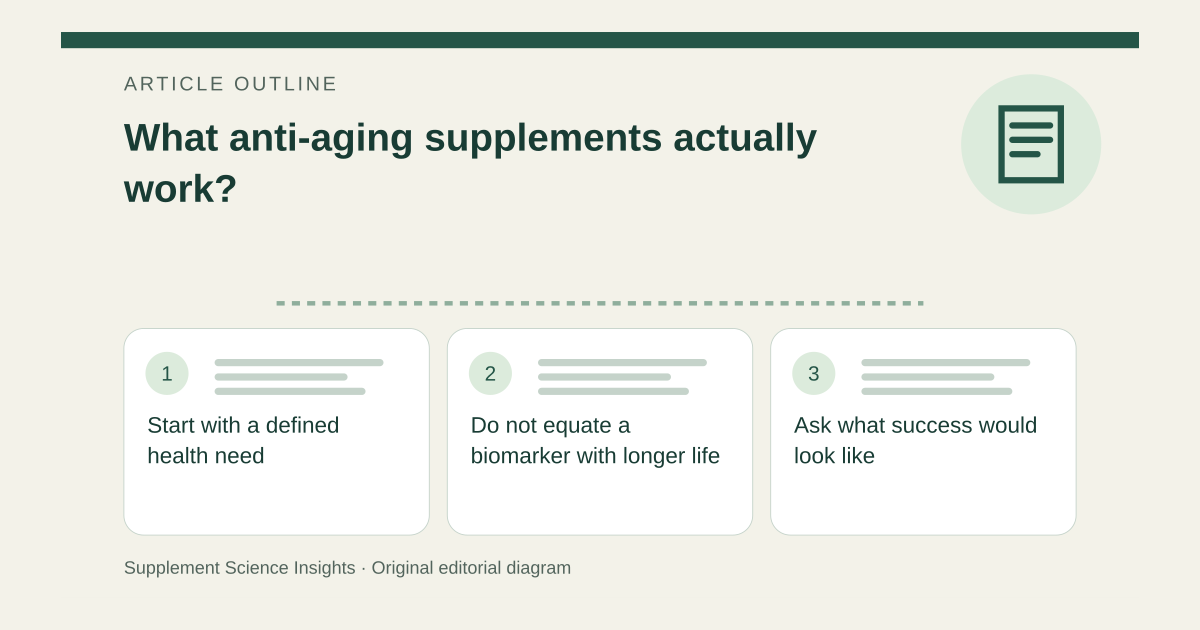
Start with a defined health need
NIA guidance describes supplementation when older adults do not obtain or absorb enough of particular nutrients, including vitamin B12. This can address a nutritional problem; it is not proof of reversing biological age. Food intake, health conditions and medicines should guide the choice rather than age alone. [1]
Do not equate a biomarker with longer life
A human rapamycin review reports selected physiological improvements and important gaps, not established lifespan extension. Skin-focused collagen research likewise concerns limited outcomes and is sensitive to study quality and funding. Neither type of finding justifies calling a whole stack a proven anti-aging treatment. [2][3]
Ask what success would look like
Imagine two products promise younger cells, but neither specifies a meaningful human outcome. That prevents a useful comparison. Discuss a concrete target such as a confirmed deficiency or functional problem, then choose an intervention with matching evidence and monitor it. More ingredients, a premium price and a biological-age score are not substitutes for demonstrated benefit. [1][4]
| Situation | Appropriate distinction |
|---|---|
| A symptom | Identify its cause |
| A marketing promise | Check the measured outcome |
| A treatment change | Review suitability and follow-up |
Sources for this article
- Dietary Supplements for Older Adults
Source consulted: 2026-09-21. This is a reference resource, not a claim that we conducted the studies or tested a product. - Targeting ageing with rapamycin and its derivatives in humans: a systematic review.
Source consulted: 2026-09-21. This is a reference resource, not a claim that we conducted the studies or tested a product. - Effects of Collagen Supplements on Skin Aging: A Systematic Review and Meta-Analysis of Randomized Controlled Trials.
Source consulted: 2026-09-21. This is a reference resource, not a claim that we conducted the studies or tested a product. - Questions and Answers on Dietary Supplements | FDA
Source consulted: 2026-09-21. This is a reference resource, not a claim that we conducted the studies or tested a product.