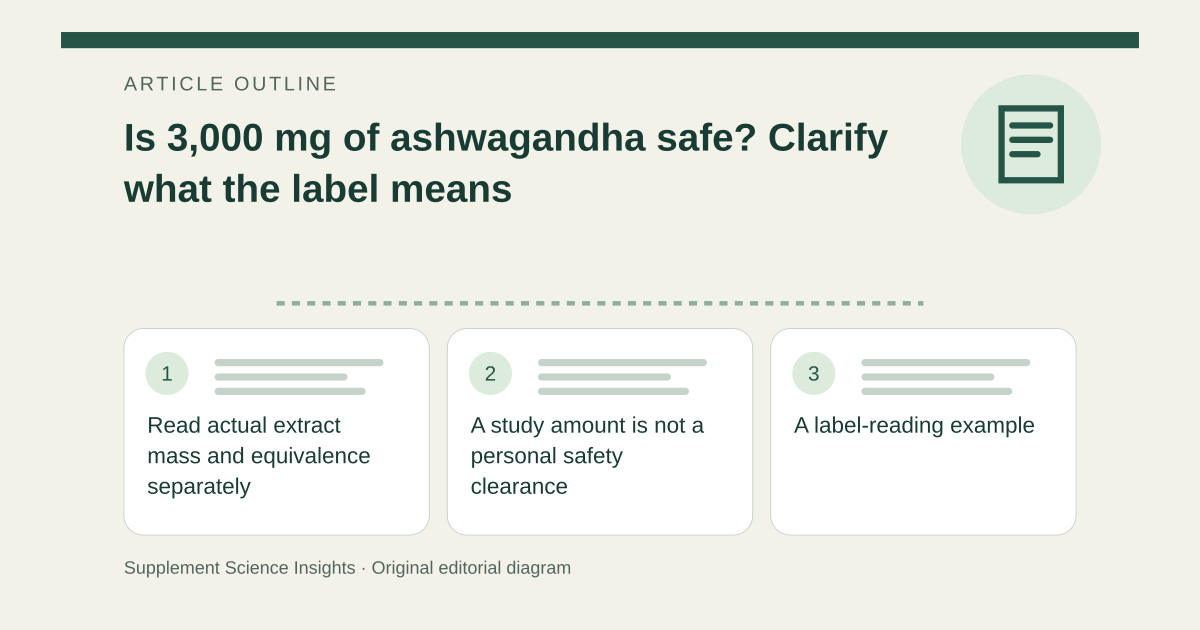
Read actual extract mass and equivalence separately
Some labels describe the starting-herb equivalent as well as the extract amount. These are not interchangeable measurements, and the extraction ratio does not fully describe every constituent. ODS notes differences between root and leaf and among study preparations, preventing a universal milligram comparison. [1][2]
A study amount is not a personal safety clearance
Short-term adult research cannot establish indefinite safety at a high amount or suitability for pregnancy, breastfeeding, thyroid or autoimmune disorders. NCCIH identifies gastrointestinal effects, drowsiness, liver reports and medicine interactions. A large headline number should prompt careful interpretation rather than automatic reassurance. [3]
A label-reading example
Imagine a serving contains 300 mg extract and claims an equivalent of 3,000 mg root. That is not the same label as 3,000 mg extract. Neither statement, by itself, proves the product is appropriate. Ask for clarification if the actual preparation or serving is unclear, and avoid escalating based on the larger marketing number. [1][2]
| Illustration | Meaning |
|---|---|
| 3,000 mg root powder | One type of exposure |
| 300 mg extract with root equivalence | A different description |
| 3,000 mg extract | Not interchangeable with either |
Sources for this article
- Ashwagandha: Is it helpful for stress, anxiety, or sleep? - Health Professional Fact Sheet
Source consulted: 2026-09-20. This is a reference resource, not a claim that we conducted the studies or tested a product. - Botanical Dietary Supplements Background Information - Consumer
Source consulted: 2026-09-20. This is a reference resource, not a claim that we conducted the studies or tested a product. - Ashwagandha: Usefulness and Safety | NCCIH
Source consulted: 2026-09-20. This is a reference resource, not a claim that we conducted the studies or tested a product.