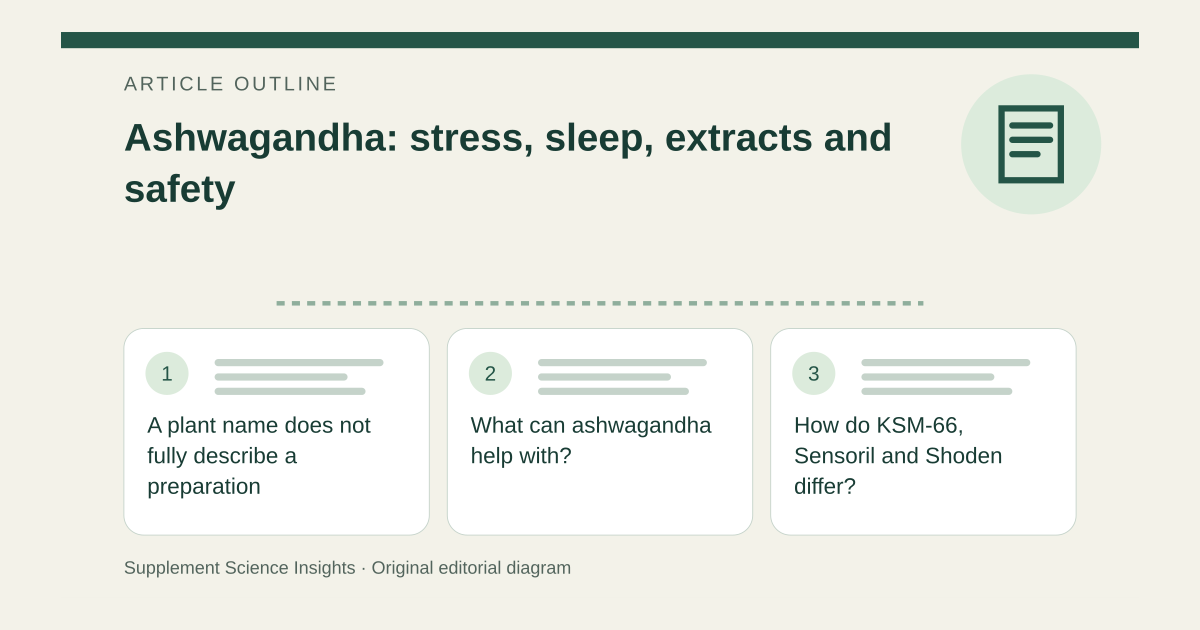
A plant name does not fully describe a preparation
Ashwagandha is Withania somnifera. NCCIH describes supplements made from root, leaf or combinations, including extracts. Trials have used varied preparations and often small samples, so a familiar plant name does not establish that a bottle matches a studied material. [1]
Start a record with the plant name, plant part, preparation, labeled amount and any stated analytical markers. An absent detail should remain “not disclosed,” not be filled in from a different product. [1]
What can ashwagandha help with?
Some ashwagandha preparations have short-term evidence for stress and sleep outcomes. That is a narrower conclusion than “balances hormones,” treats every anxiety disorder or improves every form of performance. Trials have often been small, brief and based on different extracts. [2]
NIH ODS describes studies that measured perceived stress scales, cortisol and sleep outcomes over several weeks. A cortisol change is not automatically a meaningful improvement in daily function. Separate a validated symptom score, a hormone result and a personal impression when weighing a claim. [2]
How do KSM-66, Sensoril and Shoden differ?
Commercial preparations can use root alone or root and leaf, with different extraction methods and withanolide specifications. NIH ODS describes research using root extracts such as KSM-66 and root/leaf preparations such as Sensoril or Shoden. Milligrams of different extracts are not a common potency scale. [2]
Compare the plant part, actual extract amount, standardization method and study preparation together. A higher stated percentage does not establish a better clinical outcome. Across the stress studies summarized by ODS, extract doses and durations varied substantially; selecting one dose while dropping its formulation is not an evidence-based comparison. [2]
How long does it take, and is cycling established?
The cited studies generally assessed effects over weeks, not minutes after a capsule. A result at six or eight weeks is an observation point in that study, not a promise that everyone will notice a benefit on that date. Morning versus evening use and cycling schedules are not settled by comparing unrelated trials. [2]
If a product is being considered with a clinician, define the goal, the exact preparation, the observation period and the reason to stop. Adding several new calming ingredients at once makes it difficult to tell which one helped or caused drowsiness. Long-term safety is not established by short trials. [2]
Who should avoid ashwagandha or get medical advice first?
NCCIH advises avoiding ashwagandha during pregnancy and not using it while breastfeeding. It is not recommended before surgery or for people with autoimmune or thyroid disorders. Potential interactions include sedatives, anticonvulsants, thyroid medicines, immunosuppressants and medicines for diabetes or high blood pressure. [1]
Drowsiness and digestive upset can occur, and rare reports link ashwagandha supplements to liver injury. Men with hormone-sensitive prostate cancer should avoid it. These cautions apply even when the product is advertised as natural; a lower-dose gummy is not automatically exempt. [1]
Choose an identifiable preparation before comparing value
A useful label identifies Withania somnifera, plant part, extract amount per serving, standardization and other ingredients. If those details are missing, record them as unknown rather than comparing a raw-powder weight with a concentrated extract as if they were equivalent.
Ask whether testing verifies identity, contaminants and the claimed constituents for the exact product or batch. Quality testing can strengthen confidence in contents, but it does not convert a stress trial into evidence for menopause, female fertility or testosterone treatment. Marketplace reviews and a certification logo cannot fill that clinical gap.
Read the safety boundaries before product claims
NCCIH advises avoiding ashwagandha during pregnancy and breastfeeding, and cautions about thyroid or autoimmune disorders and upcoming surgery. It reports rare liver injury, possible medication interactions and uncertainty about long-term safety. [1]
Drowsiness and gastrointestinal effects can occur. Discuss sedatives, thyroid medicines, immune-suppressing drugs and medicines for blood pressure, diabetes or seizures with a clinician. NCCIH also advises avoidance with hormone-sensitive prostate cancer. This is not a complete personal risk assessment. [1]
Matching milligrams do not establish matching preparations
Consider two invented labels: one states 300 mg root powder and the other 300 mg extract. Their stated mass matches, but the information does not establish the same composition. The example provides no extract ratio, marker profile or matched clinical evidence.
A second invented comparison might show different percentages of a marker compound. A percentage cannot establish a clinical effect without knowing what was measured and whether the preparation matches the evidence. No example here supplies a dose recommendation or potency ranking.
| Field | Label A | Label B |
|---|---|---|
| Plant part | Root | Not stated |
| Preparation | Powder | Extract |
| Declared mass | 300 mg | 300 mg |
| Composition or clinical equivalence | Not established | Not established |
Keep cautious findings cautious
NCCIH describes possible benefits for stress and insomnia with some preparations, while evidence for anxiety and other uses is less clear or insufficient. That is not a blanket finding for all ashwagandha products or a promise of a particular result. [1]
Before making a narrower claim, inspect the original trial: who participated, what preparation was used, how long it lasted, which outcome was planned, what harms occurred and who funded the work. Those details cannot be reconstructed from an advertising phrase. [1]
Separate label detail from unverified claims
Keep three columns: what the label states, what the linked document actually evaluates, and what remains unresolved. A plant-part mismatch belongs in the third column even if both documents use the same common name.
If an extract specification is unclear, ask for the specification and the relevant evidence rather than multiplying label numbers into a supposed equivalent dose. That calculation would require assumptions this page does not establish.
How to use this evidence
Use the sections above to match a question with the preparation, population and outcome actually studied. Follow the related reading for more detailed questions; a useful comparison may still end with uncertainty rather than a winning product.
This is an editorial evidence guide, not a systematic review or individual medical advice. No new clinical review credentials, product tests or personal treatment plan are implied. Study protocols and fictional value examples are identified as such.
What is known about how ashwagandha works?
Ashwagandha extracts contain several constituents, including withanolides, and root and leaf preparations differ. Proposed pathways include effects on GABA-related signaling and inflammatory processes. Much of that mechanistic work is laboratory or animal research; a pathway observed there is not a confirmed explanation for a person’s response to a capsule. [3][2]
Human trials measuring stress scores or cortisol add a different kind of evidence. A change in cortisol does not identify which constituent caused a symptom change or prove that the body’s hormones have been normalized. Keep the proposed mechanism, the extract actually tested and the measured clinical outcome separate. [3][2]
Sources for this article
- NIH NCCIH — Ashwagandha: Usefulness and Safety
Source consulted: 2026-09-17. This is a reference resource, not a claim that we conducted the studies or tested a product. - NIH ODS — Ashwagandha: Is it helpful for stress, anxiety, or sleep?
Source consulted: 2026-10-28. This is a reference resource, not a claim that we conducted the studies or tested a product. - Memorial Sloan Kettering — Ashwagandha, Mechanism of Action
Source consulted: 2026-10-28. This is a reference resource, not a claim that we conducted the studies or tested a product.
Considering a supplement?
Ingredient evidence alone does not establish which retail product is suitable. No single featured product is recommended for this article.
Compare ashwagandha formulations (retail checks pending) → No overall winner
Compare formulations → · How we select products