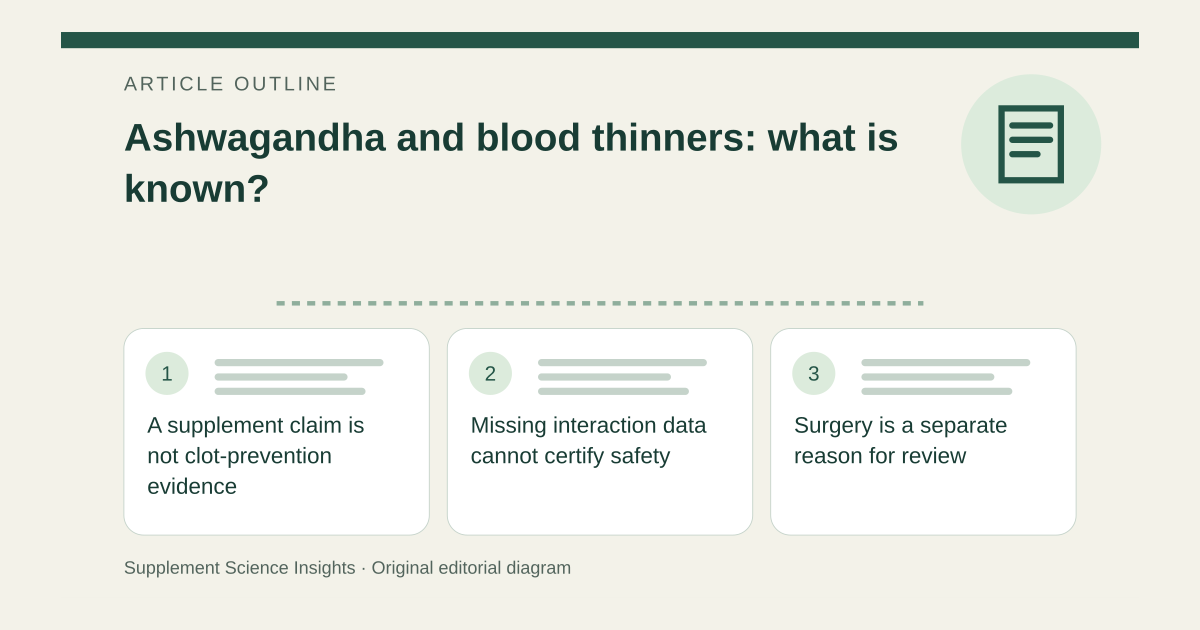
A supplement claim is not clot-prevention evidence
Neither a traditional use nor a laboratory mechanism establishes that ashwagandha prevents strokes or blood clots. It must not replace prescribed anticoagulant or antiplatelet treatment. The available summaries support caution about interactions without supplying a universal bleeding estimate. [1][2]
Missing interaction data cannot certify safety
Warfarin, direct oral anticoagulants and aspirin have different actions. A list that does not mention a particular pairing is not proof that all doses and products are safe together. Additional ingredients can change the assessment. [2]
Surgery is a separate reason for review
NCCIH advises against ashwagandha around planned surgery. Tell the surgical and prescribing teams about it and follow their specific instructions. Do not invent a universal stop interval or change the blood thinner yourself. [1]
Report unexpected bleeding rather than adjusting treatment
Imagine new bruising appears after adding an ashwagandha blend. Contact the clinician or anticoagulation service and provide the label. The timing is relevant but does not prove a mechanism; prescribed treatment and any needed monitoring require professional direction. [2]
| Detail | Why it matters |
|---|---|
| Named medicine | Different pathways |
| Complete supplement | Other active ingredients |
| Planned surgery | Specific instructions needed |
| New bleeding | Clinical assessment |
Sources for this article
- Ashwagandha: Usefulness and Safety | NCCIH
Source consulted: 2026-09-21. This is a reference resource, not a claim that we conducted the studies or tested a product. - Dietary Supplements: What You Need to Know
Source consulted: 2026-09-21. This is a reference resource, not a claim that we conducted the studies or tested a product.