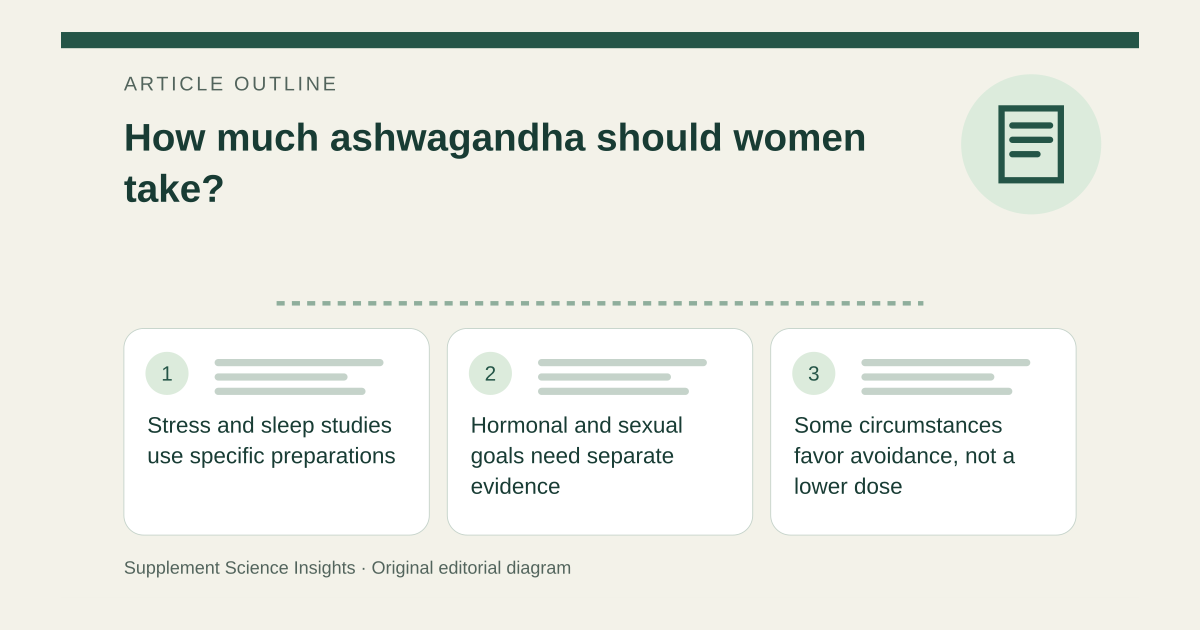
Stress and sleep studies use specific preparations
ODS describes research across a wide range of extract amounts, with several studies around 300 to 600 milligrams daily. These are study contexts, not a universal recommendation. Different marker concentrations and plant parts can make equal milligrams quite different exposures. [1]
Hormonal and sexual goals need separate evidence
Trials of perimenopausal symptoms or sexual function do not establish a routine dose for menstrual irregularity, PCOS or fertility. The hormonal review identifies a small female evidence base and no firm treatment conclusions across these conditions. [2]
Some circumstances favor avoidance, not a lower dose
NCCIH advises against use during pregnancy and breastfeeding and in people with thyroid or autoimmune disorders. A smaller serving does not establish safety in these groups. Possible medicine interactions and rare liver injury also need consideration. [3]
Read the amount actually being supplied
Imagine a bottle advertises a large root-equivalent number but contains a smaller mass of extract. Record the actual extract dose, plant part and standardization, and review the intended goal with a clinician. Do not use the headline number as a personal dosing target. [1][4]
| Goal or circumstance | Evidence boundary |
|---|---|
| Stress or sleep | Preparation-specific research |
| Fertility or PCOS | No universal established regimen |
| Pregnancy | Avoidance guidance applies |
| Root-equivalent figure | Not actual extract mass |
Sources for this article
- Ashwagandha: Is it helpful for stress, anxiety, or sleep? - Health Professional Fact Sheet
Source consulted: 2026-09-21. This is a reference resource, not a claim that we conducted the studies or tested a product. - Evaluation of Potential Hormonal Activities of Ashwagandha (Withania somnifera) - PMC
Source consulted: 2026-09-21. This is a reference resource, not a claim that we conducted the studies or tested a product. - Ashwagandha: Usefulness and Safety | NCCIH
Source consulted: 2026-09-21. This is a reference resource, not a claim that we conducted the studies or tested a product. - Dietary Supplements: What You Need to Know
Source consulted: 2026-09-21. This is a reference resource, not a claim that we conducted the studies or tested a product.