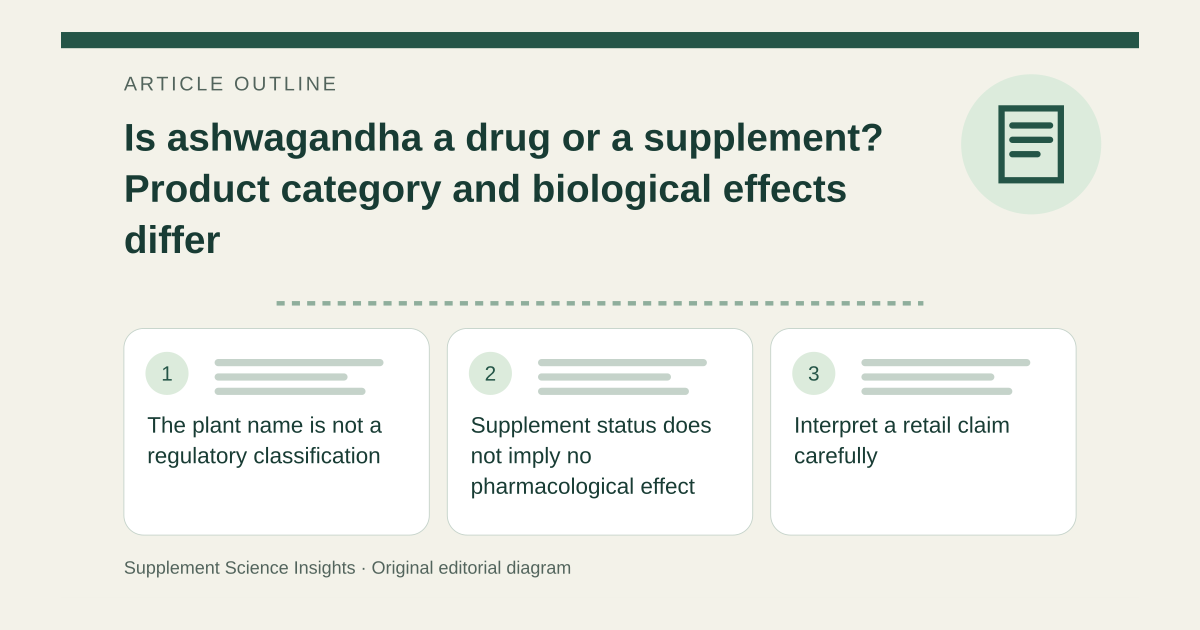
The plant name is not a regulatory classification
Ashwagandha is a botanical, Withania somnifera. How a finished product is formulated, used and marketed affects its regulatory context. NCCIH describes many oral herbal products as dietary supplements, while FDA distinguishes those products from approved medicines. A plant name alone does not settle every jurisdiction’s classification. [1][2]
Supplement status does not imply no pharmacological effect
A supplement can cause drowsiness, digestive symptoms or medicine interactions without being an approved drug. Conversely, a seller’s claim that an herb treats a disease does not establish that FDA approved that claim. The categories should not be used to infer either guaranteed benefit or guaranteed safety. [1][2]
Interpret a retail claim carefully
Imagine a bottle says natural stress support. That wording is not equivalent to an approved treatment for an anxiety disorder. Assess the evidence for its preparation and disclose use when reviewing prescribed medicines. Do not stop a prescribed treatment on the assumption that a supplement is simply its natural equivalent. [1][3]
| Illustration | Meaning |
|---|---|
| Botanical name | Plant identity |
| Dietary supplement | A product category |
| Biological effect or interaction | Can occur within that category |
Sources for this article
- Ashwagandha: Usefulness and Safety | NCCIH
Source consulted: 2026-09-20. This is a reference resource, not a claim that we conducted the studies or tested a product. - Questions and Answers on Dietary Supplements | FDA
Source consulted: 2026-09-20. This is a reference resource, not a claim that we conducted the studies or tested a product. - Dietary Supplements: What You Need to Know
Source consulted: 2026-09-20. This is a reference resource, not a claim that we conducted the studies or tested a product.