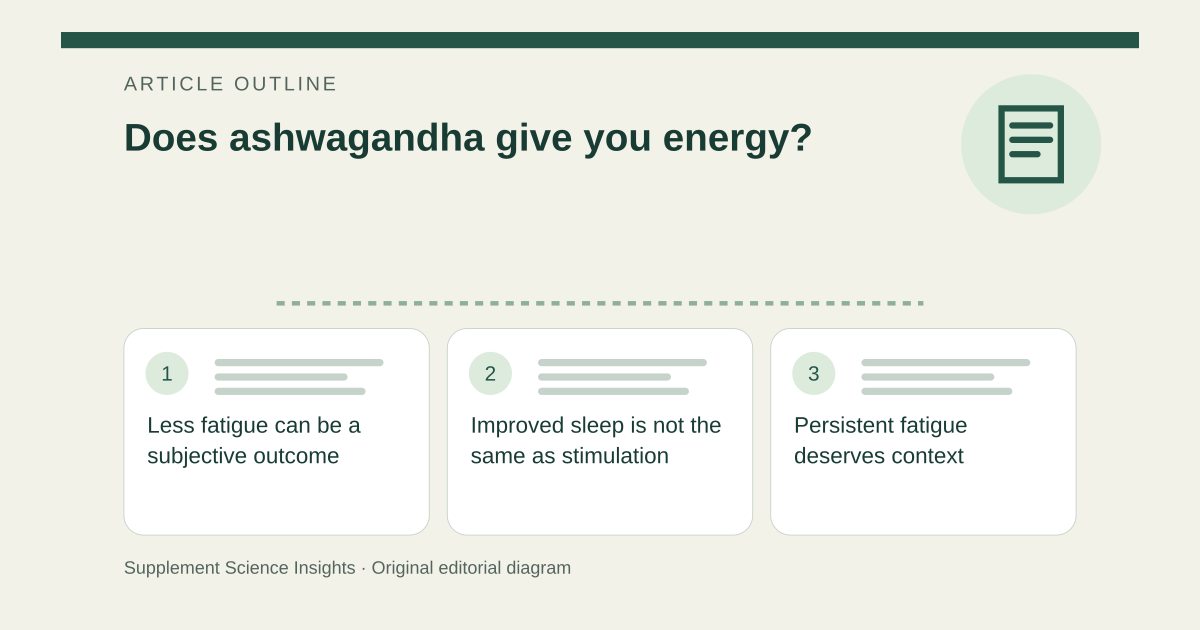
Less fatigue can be a subjective outcome
ODS summarizes multiweek studies in which some participants reported reduced fatigue alongside stress or sleep changes. These findings concern particular extracts and questionnaires. They do not demonstrate that the supplement provides an instant burst of energy or improves every form of fatigue. [1]
Improved sleep is not the same as stimulation
A person may feel more rested if sleep improves, but a proposed pathway does not prove why an individual feels different. NCCIH also lists drowsiness as a possible adverse effect, so a uniformly energizing response should not be expected. [2][1]
Persistent fatigue deserves context
Fatigue can accompany many health problems and medicine effects. An adaptogen claim cannot diagnose the cause. Thyroid conditions, pregnancy and other safety considerations may make ashwagandha inappropriate even when tiredness is the main complaint. [2][3]
Track the outcome instead of chasing a sensation
Imagine a product promises immediate energy but causes sleepiness. Do not increase it to force the promised effect. Record the formulation, timing and symptoms and discuss whether it is suitable; seek assessment for persistent unexplained fatigue. [2][3]
| Outcome | Meaning |
|---|---|
| Less questionnaire fatigue | Subjective improvement |
| Better sleep | Different endpoint |
| Immediate stimulation | Not established |
| Drowsiness | Possible adverse effect |
Sources for this article
- Ashwagandha: Is it helpful for stress, anxiety, or sleep? - Health Professional Fact Sheet
Source consulted: 2026-09-21. This is a reference resource, not a claim that we conducted the studies or tested a product. - Ashwagandha: Usefulness and Safety | NCCIH
Source consulted: 2026-09-21. This is a reference resource, not a claim that we conducted the studies or tested a product. - Dietary Supplements: What You Need to Know
Source consulted: 2026-09-21. This is a reference resource, not a claim that we conducted the studies or tested a product.