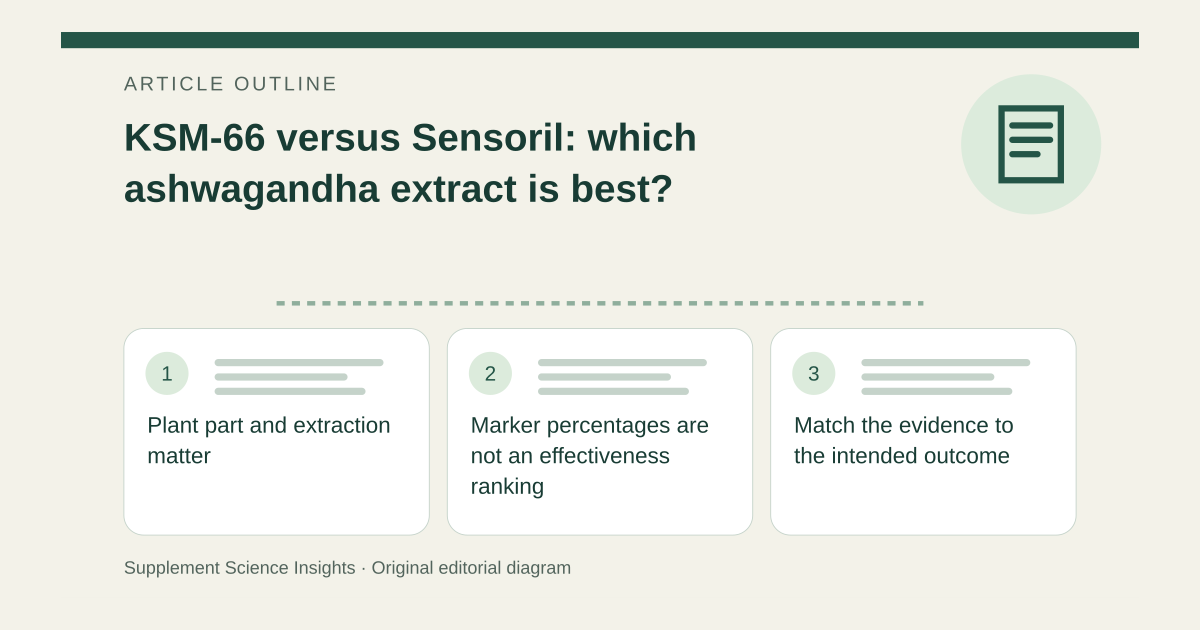
Plant part and extraction matter
ODS distinguishes root-only from root-and-leaf preparations in the clinical literature. Extraction method and chemical profile help define what was tested. The branded ingredient name provides more context than a generic herb name, but does not fully describe the finished supplement. [1]
Marker percentages are not an effectiveness ranking
A withanolide specification describes selected constituents under a particular measurement method. A botanical-extract review explains why plant-to-extract ratios and extract mass alone do not define composition or clinical strength. More concentrated does not automatically mean more suitable. [2]
Match the evidence to the intended outcome
Compare research for the relevant goal, population, amount and duration. Evidence for a root extract in a sleep trial cannot establish that another extract at the same milligram dose has identical results. The reviewed sources do not establish a universal head-to-head winner. [1]
An independently listed ashwagandha example
A directory check on September 25, 2026 found Momentous Ashwagandha in NSF Certified for Sport: 60-capsule package, one-capsule serving; the listing reports All in its lot field. This is an independently listed quality-check example, not a clinical winner. It does not certify another brand, a different pack or flavor, or an Amazon seller. Recheck the exact entry and your lot before purchase. [5][6]
Safety can decide before brand preference
Imagine two products both advertise stress support. Check the actual serving, additional ingredients and medicine interactions before choosing on a percentage claim. Pregnancy, thyroid disorders, autoimmune conditions and liver concerns remain relevant to either branded botanical. [3][4]
| Feature | Why it matters |
|---|---|
| Root versus root and leaf | Different starting material |
| Extract milligrams | Not raw-root equivalence |
| Marker percentage | Not proven clinical superiority |
| Matched clinical trial | More informative than a ranking |
Sources for this article
- Ashwagandha: Is it helpful for stress, anxiety, or sleep? - Health Professional Fact Sheet
Source consulted: 2026-09-21. This is a reference resource, not a claim that we conducted the studies or tested a product. - Understanding plant to extract ratios in botanical extracts - PMC
Source consulted: 2026-09-21. This is a reference resource, not a claim that we conducted the studies or tested a product. - Ashwagandha: Usefulness and Safety | NCCIH
Source consulted: 2026-09-21. This is a reference resource, not a claim that we conducted the studies or tested a product. - Dietary Supplements: What You Need to Know
Source consulted: 2026-09-21. This is a reference resource, not a claim that we conducted the studies or tested a product. - NSF Certified for Sport directory: Momentous Ashwagandha
Source consulted: 2026-09-25. This is a reference resource, not a claim that we conducted the studies or tested a product. - NSF Certified for Sport: what the mark means
Source consulted: 2026-09-25. This is a reference resource, not a claim that we conducted the studies or tested a product.