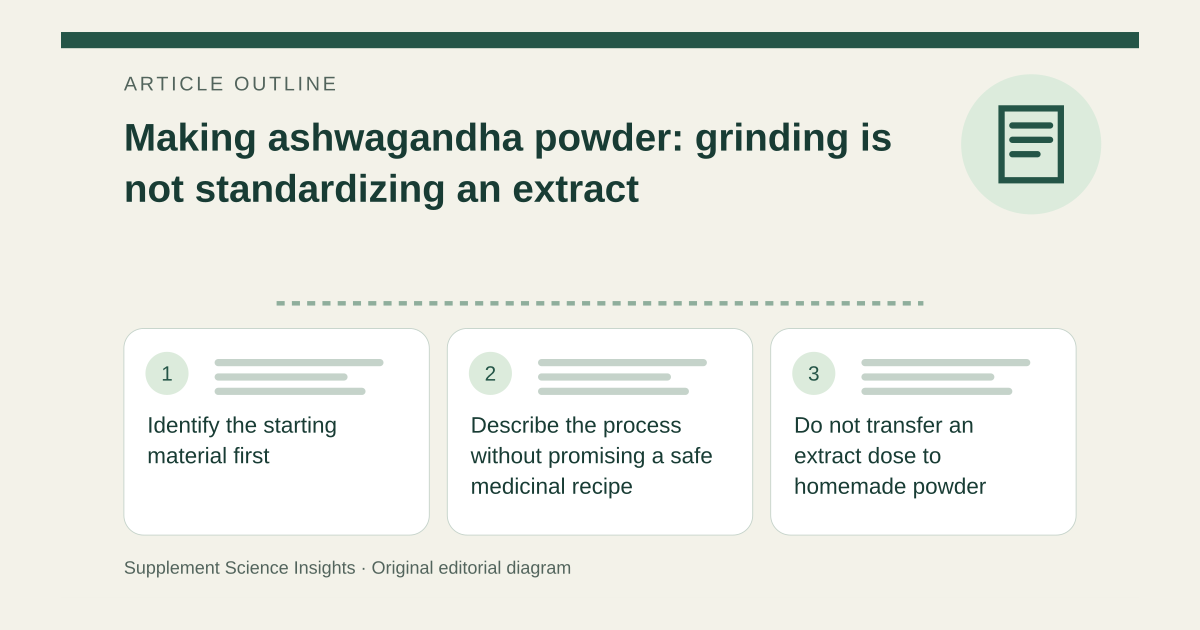
Identify the starting material first
Ashwagandha root and leaf have different chemical profiles. A common name or an unlabeled dried root is insufficient for reliable identification. If the starting material is not authenticated and appropriate for its intended use, grinding it more finely does not solve that problem. [1]
Describe the process without promising a safe medicinal recipe
At a conceptual level, powder production involves correctly identified material, controlled drying and size reduction. Home grinding changes particle size; it does not create a standardized extract or establish the amount of withanolides. Moisture control also matters because damp storage can support deterioration. [2][3]
Do not transfer an extract dose to homemade powder
Imagine a study used a defined extract while a home jar contains ground root of uncertain strength. Equal milligrams are not equivalent interventions. The preparation still carries ashwagandha’s safety concerns, and this process description is not a validated home manufacturing method or dosing recommendation. [1][4]
| Illustration | Meaning |
|---|---|
| Grinding | Changes particle size |
| Standardized extract | Requires defined processing and measurement |
| Homemade powder amount | Not a validated clinical dose |
Sources for this article
- Ashwagandha: Is it helpful for stress, anxiety, or sleep? - Health Professional Fact Sheet
Source consulted: 2026-09-20. This is a reference resource, not a claim that we conducted the studies or tested a product. - Botanical Dietary Supplements Background Information - Consumer
Source consulted: 2026-09-20. This is a reference resource, not a claim that we conducted the studies or tested a product. - Food Storage Conditions — Utah State University Extension
Source consulted: 2026-09-20. This is a reference resource, not a claim that we conducted the studies or tested a product. - Ashwagandha: Usefulness and Safety | NCCIH
Source consulted: 2026-09-20. This is a reference resource, not a claim that we conducted the studies or tested a product.